

Image source: cdn.mos.cms.futurecdn.net
Titan: A World of Promise and Challenge
Saturn's largest moon offers a thick atmosphere and liquid hydrocarbon seas, but reaching it remains a distant dream.
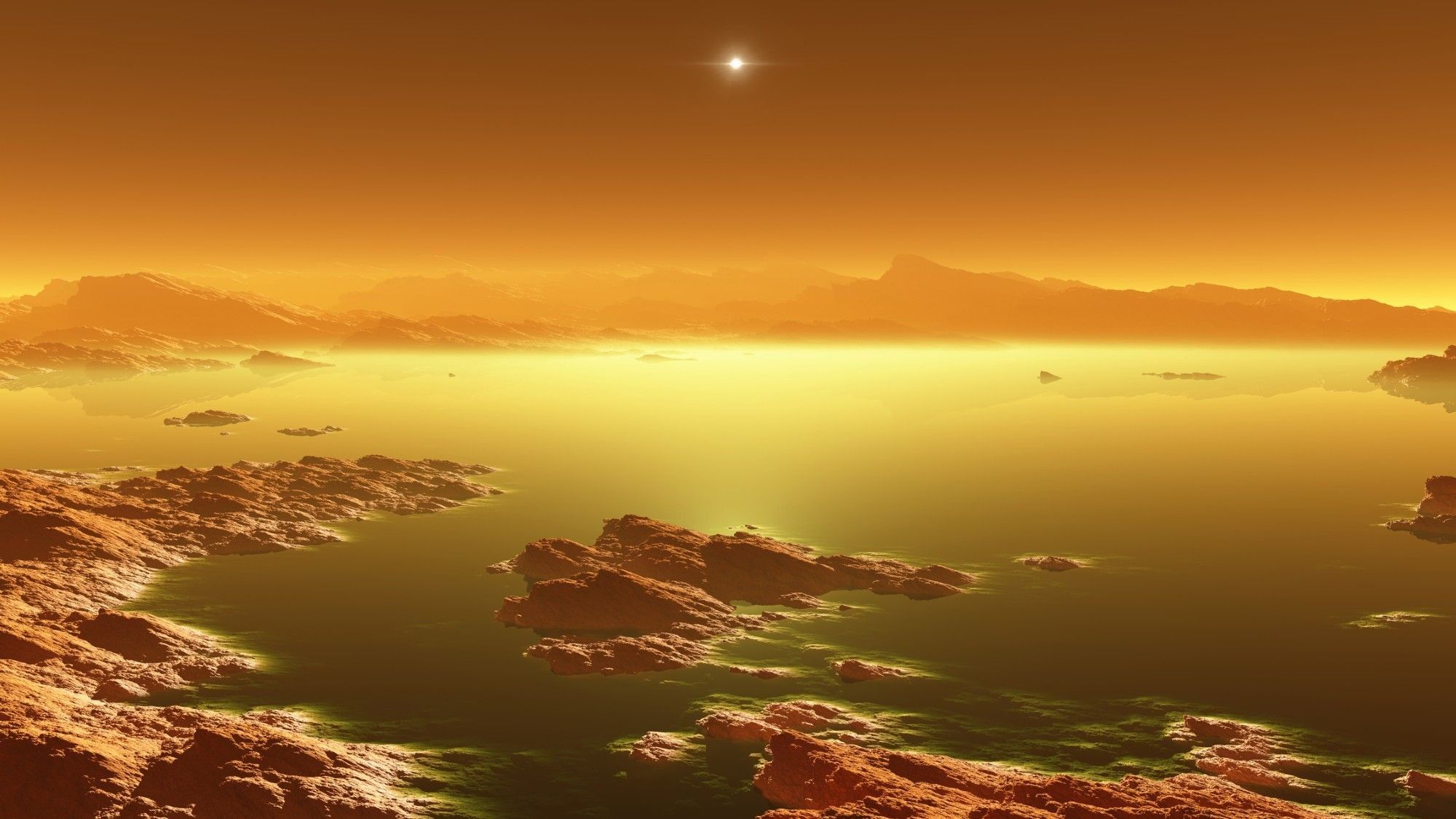
Saturn's largest moon, Titan, has long captivated scientists with its thick atmosphere, clouds, rain, and vast rivers, lakes, and seas of liquid methane and ethane. This unique environment makes it one of the most intriguing destinations in the solar system for future exploration. However, the question of whether humans will ever set foot on Titan—or whether advanced humanoid robots will take on the mission—was the central topic of the Humans to Titan Summit, held June 11-12 in Boulder, Colorado.
Pascal Lee, chairman of the Mars Institute and a planetary scientist at the SETI Institute, described the summit as both exciting and futile. "The futile part comes from the fact that humans going to Titan is a longer-term goal in an age where technology is evolving so quickly," Lee told Space.com. "But it has to be done and it's worth doing as it gives us some sense of direction."
While human exploration of Titan remains decades away, the rapid advancement of artificial intelligence (AI) and humanoid robotics is reshaping the conversation. Lee emphasized that the emergence of android robots imbued with AI could fundamentally alter how we explore space, potentially making human voyages to distant worlds less necessary.
The Rise of Android Robots
AI-powered humanoid robots are advancing quickly, potentially offering a safer and more cost-effective alternative to human astronauts.
Lee noted that a revolution is taking place on Earth with the development of android robots capable of performing tasks once reserved for humans. "Android robots have exceeded in many ways the performance of many humans," he said. "They can run, jump, do acrobatics, and with AI it doesn't take a visionary to see that you essentially get an artificial human."
These robots, unlike humans, do not require food, air, sleep, or waste management. "It has all the usefulness of a human being and none of the risks and shortcomings, along with the cost of sending humans," Lee explained. "It automatically becomes your best exploration system, and behaves like a biological human, but minus the biology. That's our future in space."
Lee pointed to a specific example: the Walker S2 humanoid robot developed by China's UBTech Robotics. This robot can swap its own depleted battery for a fresh one, a capability Lee described as mimicking mortality and enabling fully autonomous, 24/7 operation. He also noted that the race to develop such robots is intensifying between the United States and China.
From Earth Analogs to Titan
Arctic field research could serve as a training ground for human-robot collaboration, paving the way for Titan exploration.
Lee suggested that analog field research sites, such as the NASA Haughton-Mars Project on Devon Island in the Arctic, could be used to train humanoid robots for space exploration. "My hope is that on Devon Island we could start working with AI and 'able-to-learn' android robots. You could train an android robot to be a field assistant," he said.
Looking ahead, Lee envisions a scenario where android robots establish infrastructure on Titan before humans ever arrive. "Once an android-installed infrastructure on that distant Saturnian moon is set up, humans could make an official visit to the facility, completely run by robots," he said.
Lee concluded by framing Titan as a stepping stone beyond Mars. "I think, ultimately, we think of Titan as the next big leap beyond Mars. But to me Titan is even more interesting as the last leap before interstellar travel."
Uncertainties and Open Questions
The timeline for human or robotic Titan exploration remains unclear, as does the question of whether AI can match human intelligence.
Despite the optimism surrounding humanoid robots, significant uncertainties remain. Lee acknowledged that achieving artificial general intelligence (AGI)—AI that can match human cognitive abilities—is a key milestone. "Artificial 'super intelligence' is actually having the complexity and subtleties of human thinking," he said. Whether such an android would have a soul or be self-aware is, in Lee's view, more speculative. "But it certainly can get to the point where it becomes a very objective observer and scientist."
The summit highlighted the tension between the allure of human exploration and the pragmatic potential of robotics. While no concrete plans or timelines for a Titan mission were announced, the discussion underscores a broader shift in space exploration strategy: as AI and robotics advance, the role of human astronauts may evolve from explorers to overseers of robotic pioneers.
Based on reporting from space.com

