

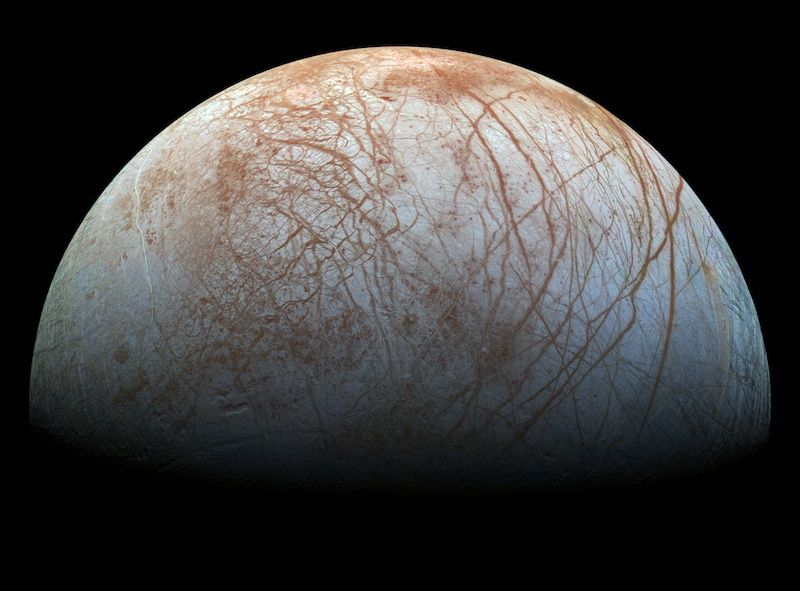
Europa's Hidden Ocean May Still Harbor Life, Study Finds

📷 Image source: earthsky.org
A Glimmer of Hope in an Icy Shell
New research challenges assumptions about habitability
The search for life beyond Earth has long been fixated on Mars, but a new study suggests we should keep our eyes on a more distant, icy world. According to research highlighted by earthsky.org, the subsurface ocean on Jupiter's moon Europa may still possess the necessary chemical ingredients to support life, even if its surface is bombarded by radiation. This finding directly challenges a long-standing concern that radiation would destroy crucial molecules called oxidants before they could ever reach the ocean below.
The core of the argument, as presented by the researchers, hinges on a simple but profound possibility: what if the oxidants aren't delivered from above at all? The study posits that these vital compounds could be generated within the ocean itself through the interaction of water with rocks on the seafloor. This internal production mechanism could provide a steady, shielded supply of nutrients, independent of the harsh surface environment. It's a paradigm shift that reopens the door to Europa's potential as a living world.
The Radiation Conundrum and a New Solution
Why surface delivery may not be the only path
For decades, the prevailing model for Europa's habitability relied on a slow trickle-down effect. The theory was that radiation from Jupiter's powerful magnetic field would split water ice (H2O) on the moon's surface, creating oxidants like oxygen and hydrogen peroxide. These oxidants would then, over millions of years, be mixed downward through the icy crust by geological processes, eventually reaching the liquid ocean to provide a potential energy source for any microbial life.
However, this model has a critical weakness: the very radiation that creates these oxidants also relentlessly breaks them down. The new research, led by planetary scientist Mark Hesse from the University of Texas at Austin, used numerical models to examine this process. According to the earthsky.org report, his team's calculations suggest that the radiation would destroy the oxidants faster than geological processes could bury them. The oxidants would essentially be 'burned up' long before reaching the ocean, starving any potential life of a key energy source.
This is where the new hypothesis offers a compelling alternative. If oxidants cannot reliably survive the journey from the surface, then perhaps they don't need to make that journey at all.
Seafloor Chemistry as a Life-Sustaining Engine
How water-rock interactions could fuel an ecosystem
The proposed solution turns our gaze from the irradiated surface to the dark, high-pressure seafloor. The research suggests that the necessary oxidants could be produced *in situ* through water-rock interactions at the ocean floor. This process, known as serpentinization, occurs when seawater reacts with rocky minerals like olivine.
During serpentinization, the iron in the rock oxidizes, and as a byproduct, hydrogen is released. This hydrogen is a potent reductant—the perfect counterpart to an oxidant. More critically, the chemical reactions can also produce other oxidants directly within the water. According to the earthsky.org summary of the study, this means the ocean could be actively creating its own chemical energy gradient, the fundamental requirement for life as we understand it. The ocean itself becomes a self-contained biochemical reactor, insulated from the destructive radiation above by miles of solid ice.
Implications for the Europa Clipper Mission
Shifting the focus of the search
This new research has direct and profound implications for NASA's upcoming Europa Clipper mission, scheduled to launch later this decade. The spacecraft is designed to conduct dozens of close flybys of the icy moon, mapping its surface and subsurface in unprecedented detail. A primary goal is to assess its habitability.
If oxidant delivery from the surface is inefficient, then missions like Clipper may need to reinterpret the data they collect about surface chemistry. A low detection of surface oxidants would no longer necessarily spell doom for the ocean below. Instead, the focus for assessing habitability shifts toward understanding the geology of the seafloor. The study emphasizes that the potential for oxidant production depends heavily on the composition of Europa's rocky interior and the temperature of the ocean. Clipper's instruments, which will probe the ice shell and measure the moon's gravitational field, will now be scrutinized for clues about these deep, hidden processes.
The Broader Picture of Ocean World Habitability
Lessons for Enceladus and beyond
Europa is not the only moon in our solar system with a subsurface ocean. Saturn's moon Enceladus, for instance, actively vents its ocean material into space from geysers at its south pole. Data from the Cassini mission confirmed the presence of a variety of organic molecules and hydrogen in those plumes—direct evidence of ongoing water-rock interactions on its seafloor.
The new model for Europa effectively places it in the same category as Enceladus: an ocean world whose life-support potential is driven primarily by internal geochemistry rather than surface processes. This reframing helps planetary scientists develop a more unified theory of habitability for icy moons. It suggests that the key to finding life lies not in analyzing a frozen, irradiated surface, but in deducing the conditions at the interface where a salty ocean meets a rocky core. The engine for life, it seems, may be powered from below.
Unanswered Questions and Future Exploration
What we still need to know
While the new hypothesis is compelling, it is not yet proven. The research, as reported by earthsky.org, is based on computer modeling. Confirmation requires direct evidence from Europa itself. A critical unknown is the actual temperature of Europa's ocean. If the water is too cold, the chemical reactions of serpentinization may proceed too slowly to be significant.
Furthermore, the composition of the seafloor rock is a major variable. Is it similar to Earth's mantle, rich in olivine, or something else entirely? The Europa Clipper mission will gather data to help constrain these variables, but a definitive answer may require a lander or even a submersible probe that could one day melt through the ice—a monumental technological challenge. The study does not claim Europa has life; it robustly argues that a previous obstacle to life may not be as insurmountable as once thought. The door to possibility, firmly shut by the radiation problem, is now convincingly cracked back open.
A Timeline of Discovery and Speculation
Humanity's understanding of Europa has evolved dramatically since the Voyager flybys in the late 1970s first hinted at its cracked, icy surface. The Galileo mission in the 1990s provided strong evidence for the global ocean, transforming it from a curious ice ball into a prime astrobiological target. For years, the narrative was defined by the 'surface delivery' model of oxidants.
The research highlighted by earthsky.org, published on 2026-01-28T14:02:28+00:00, represents a significant pivot in that narrative. It is part of an ongoing scientific dialogue where each new model or piece of data refines the questions we ask. The debate between surface-delivered versus internally-generated oxidants will likely continue until we can directly sample the ocean or its plumes. What this study provides is a robust, chemically-plausible pathway for habitability that exists independently of the harsh surface environment, ensuring Europa remains one of the most tantalizing destinations in our solar system.
Why This Matters for the Human Story
The quest to understand if we are alone in the universe is fundamentally a quest to understand the conditions that give rise to life. Europa, a world with no atmosphere, bathed in lethal radiation, and hidden under an ice shell miles thick, seems an unlikely oasis. Yet, this research underscores a powerful principle: life is tenacious and may exploit niches we have yet to fully imagine.
Finding even simple microbial life in Europa's dark ocean would revolutionize biology and our place in the cosmos. It would prove that life can originate and persist independently in a second, isolated ecosystem within our own solar system. The new hypothesis doesn't make that discovery more likely in a statistical sense, but it strengthens the scientific rationale for looking. It tells us that the tools for life could be there, forged in the darkness under pressure and heat, waiting for a probe from a distant, rocky world to finally take notice.
#Europa #Astrobiology #SpaceScience #JupiterMoon #OceanWorlds


