

Astronomers Capture Clearest Glimpse Yet of the Universe's Dark Matter Skeleton

📷 Image source: earthsky.org
A Strand in the Cosmic Tapestry
New image reveals the hidden framework of the universe
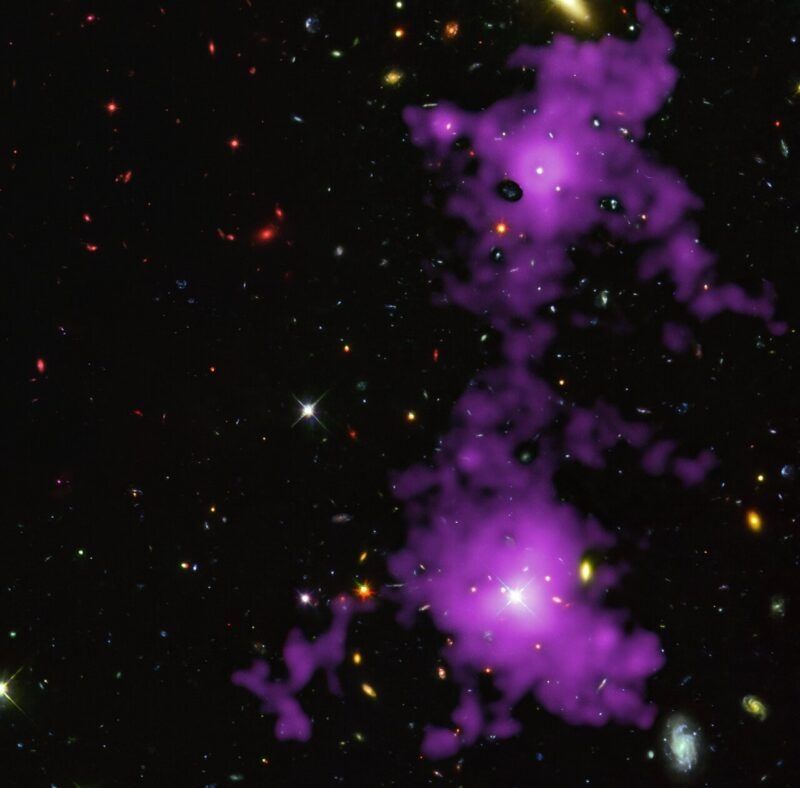
For decades, cosmologists have theorized that the universe is structured like a vast, intricate web. This cosmic web, composed primarily of the mysterious substance known as dark matter, forms the invisible scaffolding upon which galaxies are built and arranged. Now, a groundbreaking observation has brought this theoretical framework into startlingly clear view. According to earthsky.org, astronomers have captured the clearest image yet of a single filament of this web, a thread of dark matter stretching through the immensity of space. This isn't an artist's impression or a simulation; it's a direct, observational peek at the hidden architecture that dictates the large-scale structure of everything we see.
The image, published by earthsky.org on February 11, 2026, represents a significant leap in our understanding of cosmic evolution. Dark matter, which does not emit, absorb, or reflect light, has only been inferred through its gravitational effects on visible matter. Seeing—or rather, mapping—a filament so distinctly provides crucial empirical evidence for the models that describe how the universe grew from a nearly uniform state after the Big Bang into the complex, clustered realm of galaxies and voids we observe today.
Gravitational Lensing: The Universe's Magnifying Glass
How scientists revealed the invisible
The key to visualizing the invisible lies in a phenomenon predicted by Einstein's theory of general relativity: gravitational lensing. Massive objects warp the fabric of spacetime around them, bending the path of light from more distant objects behind them. This effect acts as a natural cosmic telescope, distorting and magnifying the images of background galaxies. The dark matter filament itself, while invisible, possesses immense mass. Its gravity subtly distorts the shapes of millions of faraway galaxies that lie in a fortuitous line of sight behind it.
By meticulously analyzing these tiny, systematic distortions—a technique known as weak gravitational lensing—the research team was able to reconstruct the mass and shape of the filament causing them. It's akin to deducing the shape of a glass lens by studying how it warps the view of a patterned wall behind it. The resulting map shows the distribution of mass, revealing the dark matter thread in stunning detail. This method transforms the cosmos itself into a tool for discovery, allowing astronomers to chart the distribution of all matter, seen and unseen, by reading the subtle warps in starlight.
Connecting Galactic Islands
The newly imaged filament is not floating in isolation. According to the report from earthsky.org, it acts as a bridge between two massive clusters of galaxies. This is a textbook prediction of the cosmic web model. Galaxy clusters, the largest gravitationally bound structures in the universe, are understood to form at the dense intersections of web filaments. The vast, empty regions known as cosmic voids lie between these threads. The filament is the cosmic highway along which gas and smaller galaxy groups flow, feeding the growth of the colossal clusters at its ends.
Observing this connection so clearly validates a core pillar of modern cosmology. It demonstrates that dark matter is not just a passive component but the active framework guiding the assembly of visible structures over billions of years. The distribution of galaxies we see today is a direct imprint of the underlying dark matter skeleton, with bright clusters shining at the nodes of this shadowy network.
The Scale of the Unseen Structure
The sheer scale of the structure revealed is difficult to comprehend. While the exact dimensions from this specific observation are detailed in the scientific publication cited by earthsky.org, filaments of the cosmic web are known to be among the most immense structures in existence. They can stretch for hundreds of millions of light-years across the intergalactic void, yet they are also incredibly diffuse. Their density, while much higher than the near-vacuum of cosmic voids, is still far less than that of a galaxy cluster.
This diffuse nature is precisely what has made them so challenging to detect directly. Their gravitational lensing signal is extremely faint, requiring the statistical analysis of distortions across an enormous field of view containing countless background galaxies. Capturing this signal required deep, wide-field observations and sophisticated computational techniques to separate the subtle filament signature from noise and other gravitational effects.
Implications for Understanding Dark Matter
More than just a pretty picture
This image is far more than a cosmological curiosity. It serves as a powerful new constraint for understanding the fundamental properties of dark matter itself. The report states that by measuring how the mass is distributed along the filament's length, scientists can test theories about how dark matter particles behave. For instance, does dark matter interact with itself other than through gravity? Certain theoretical models predict that dark matter with even a slight degree of self-interaction would cause filaments to be more smoothed out or have different density profiles compared to the 'cold, collisionless' dark matter that is the standard model.
The observed structure of the filament, its width, and how its density changes from the center to the edges provide real-world data to pit these theories against. A clear, high-fidelity map of a filament acts as a cosmic laboratory, offering clues to the particle physics nature of the universe's dominant form of matter—a substance that remains five times more abundant than the ordinary atoms that make up stars, planets, and us.
The Technological Triumph Behind the Discovery
Achieving this clarity was a feat of both astronomical instrumentation and data science. It likely involved combining data from powerful space-based telescopes, which provide sharp, deep images without atmospheric distortion, and large ground-based surveys that cover vast swathes of the sky. The analysis required processing petabytes of imaging data to measure the precise shapes of millions of faint galaxies, correcting for instrumental effects and the natural blurring of the atmosphere, and then applying complex statistical algorithms to tease out the coherent distortion pattern caused by the filament.
This work sits at the frontier of what's known as precision cosmology. It exemplifies the shift from simply discovering cosmic structures to measuring their properties with enough accuracy to answer profound physical questions. The filament image is a testament to decades of advancement in telescope design, camera technology, and computational power, all converging to illuminate the darkest corners of our universe.
The Cosmic Web's Role in Galaxy Formation
Understanding the cosmic web is inextricably linked to understanding the birth and life of galaxies. According to cosmological models, after the Big Bang, slight overdensities in the dark matter distribution grew under gravity, forming the web's filaments and nodes. Ordinary matter—hydrogen and helium gas—was pulled along into this dark matter framework. The filaments are thought to be the channels through which vast reservoirs of primordial gas flow, cooling and condensing until gravity triggers the formation of stars and galaxies.
This process is why galaxies are not scattered randomly but are found along filaments and gathered into clusters at their intersections. The new image provides a snapshot of this ongoing process. By studying the relationship between the dark matter filament and the galaxies embedded within and around it, astronomers can learn more about the efficiency of galaxy formation, how galaxies are fed by these cosmic streams, and why some regions become bustling galactic cities while others remain desolate voids.
A New Era of Mapping the Invisible Universe
The successful capture of this dark matter filament heralds a new chapter in extragalactic astronomy. It proves that the techniques of weak gravitational lensing have matured to the point where they can map the cosmic web in detail. This single filament is likely just the beginning. Upcoming observatories, like the Vera C. Rubin Observatory and the Nancy Grace Roman Space Telescope, are designed to survey the sky with unprecedented speed and depth. They will collect weak lensing data for billions of galaxies, enabling astronomers to move from imaging individual filaments to charting the entire local cosmic web in three dimensions.
Such a map would be a transformative achievement, a census of the universe's total mass distribution. It would allow scientists to trace the growth of the web over cosmic time, test gravity on the largest scales, and further narrow down the identity of dark matter. As stated in the report from earthsky.org, this clearest image yet is not an endpoint, but a beacon, illuminating the path toward a more complete and detailed understanding of the universe's hidden structure and its dramatic history of construction from the dawn of time.
#DarkMatter #CosmicWeb #Astronomy #GravitationalLensing #SpaceDiscovery


