

Image source: assets.science.nasa.gov
A Cosmic Firework for a Milestone Anniversary
NASA celebrates 250 years of US history with a Hubble image of red, white, and blue stars
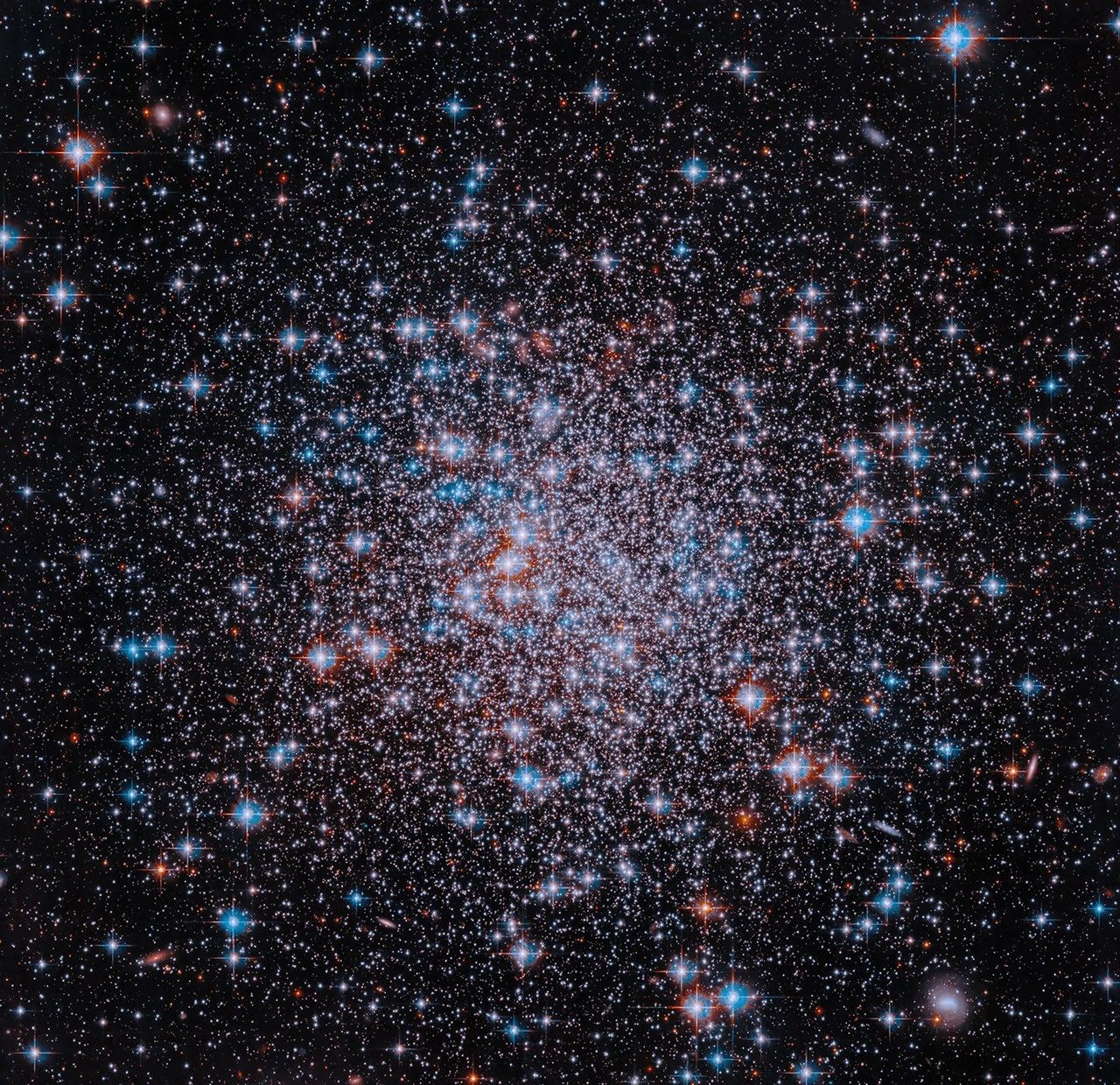
NASA’s Hubble Space Telescope has released a striking new image of the globular cluster NGC 6426, a dense spherical swarm of stars located in the outer halo of the Milky Way. The image, which features stars in red, white, and blue—reminiscent of a sparkler waved on a dark night—was released to commemorate the 250th anniversary of the United States. The agency framed the release as part of America’s ongoing legacy of exploration, linking a celestial phenomenon to a national milestone.
The cluster itself is one of about 150 known globular clusters in our galaxy. These ancient stellar groupings are thought to form from a single collapsing gas cloud, giving their member stars similar ages. NGC 6426 is particularly old: at approximately 13 billion years, it is nearly as ancient as the universe itself, which is estimated to be 13.7 billion years old. This makes it one of the Milky Way’s oldest globular clusters, offering astronomers a window into the early cosmos.
What the Colors Reveal About Stellar Populations
Blue indicates hotter stars; red shows cooler ones and near-infrared light
In the Hubble image, the colors are not arbitrary. Blue represents shorter wavelengths of visible light, while red indicates longer visible wavelengths and some near-infrared light. Because a star’s color is directly tied to its surface temperature, the blue stars in NGC 6426 are hotter, and the red stars are cooler. These hues are chosen through standard image processing techniques that best represent the wavelengths of light captured by Hubble’s filters.
Beyond color, the stars of NGC 6426 have low metallicity—meaning they contain fewer elements heavier than hydrogen and helium. This chemical simplicity mirrors conditions in the early universe, when matter was mostly hydrogen and helium, and heavier elements had only just begun to form through nuclear fusion inside massive stars. Researchers have identified two chemically distinct populations of stars within the cluster. The slightly younger, more metal-rich group appears to have been enriched by material from earlier supernovae—explosive deaths of massive stars that seeded the cosmos with heavier elements. This process is fundamental to the formation of new stars and planets.
A Window into Galaxy Formation
Hubble’s study of globular clusters in the Milky Way’s halo
Hubble captured NGC 6426 as part of a broader study of globular clusters in the Milky Way’s halo, the diffuse outer region of our galaxy. The goal of this research is to determine the ages of these clusters and shed light on how the Milky Way formed and evolved over billions of years. Because globular clusters are so old, they serve as fossil records of the early universe, preserving information about the conditions and processes that shaped galaxies.
Over its more than three decades in orbit, Hubble has fundamentally transformed our understanding of the cosmos. Its discoveries are now being expanded and complemented by newer observatories, including the infrared-sensitive James Webb Space Telescope and the upcoming Nancy Grace Roman Space Telescope, which is scheduled to launch in late summer. Together, these missions continue to explore the unknown in space and air, with NASA emphasizing that such work is carried out for the benefit of humanity and to inspire the world through discovery.
Context and Significance
What remains uncertain and why this matters for global readers
While the Hubble image provides a stunning visual, it also underscores several areas of ongoing scientific inquiry. For instance, the exact mechanisms that led to the two chemically distinct populations within NGC 6426 are not fully understood. The enrichment by supernovae is a leading hypothesis, but the timing and efficiency of that process remain subjects of study. Additionally, the cluster’s low metallicity raises questions about how such ancient systems formed in the early universe, when heavy elements were scarce.
For a global audience, the image serves as a reminder that the universe’s history is written in starlight. Globular clusters like NGC 6426 are not unique to the Milky Way—they exist in galaxies across the cosmos, and studying them helps astronomers piece together the timeline of cosmic evolution. The release also highlights NASA’s role in using space exploration to mark national milestones, a practice that blends civic celebration with scientific outreach. As the James Webb and Roman telescopes come online, the data from Hubble will continue to provide a crucial baseline for understanding the oldest stellar populations in our galaxy and beyond.
Based on reporting from science.nasa.gov

