

Image source: sciencedaily.com
A Cosmic Fireworks Display for a Milestone Anniversary
NASA releases Hubble image of globular cluster NGC 6426 to mark 250 years of U.S. exploration
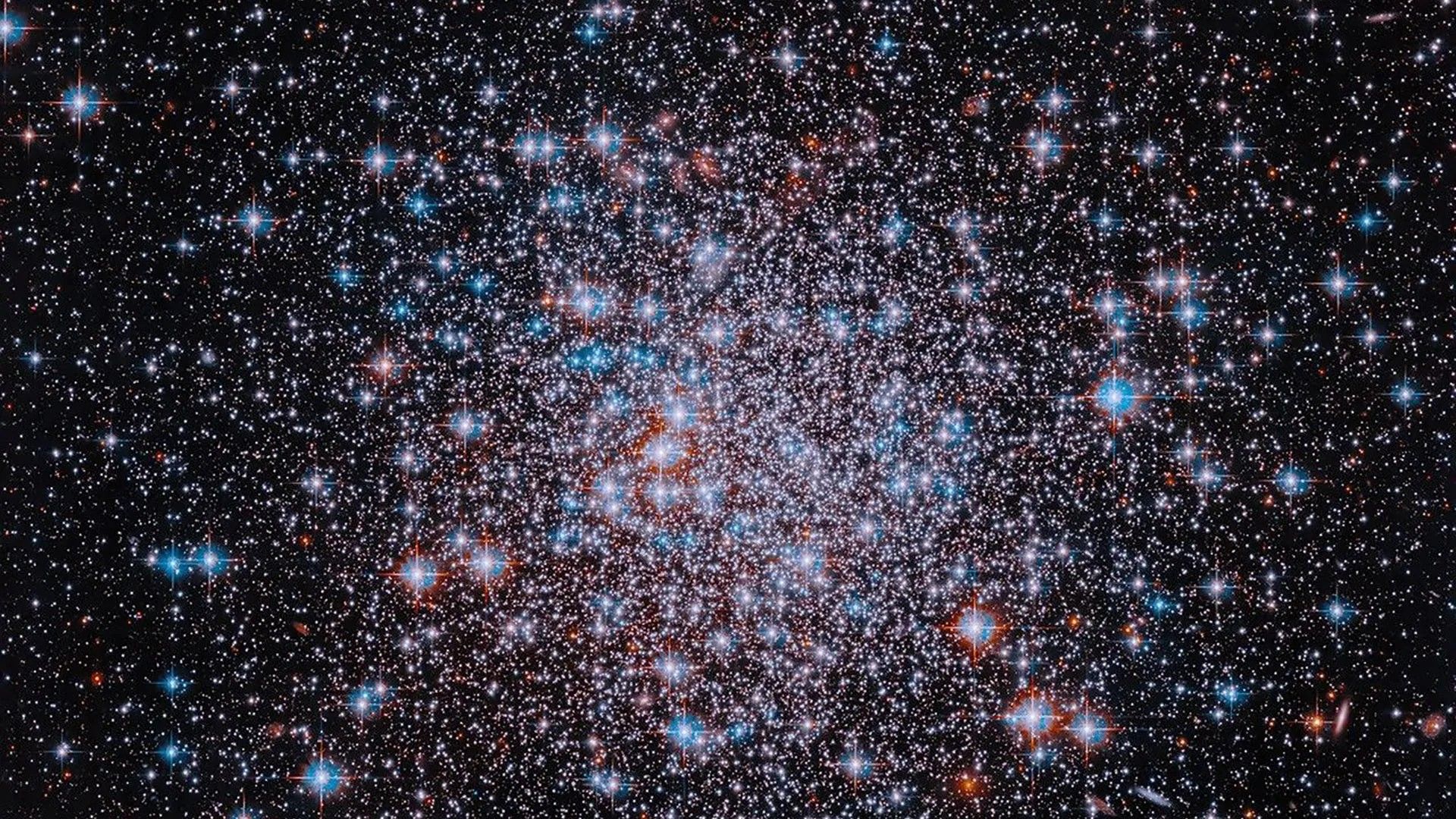
NASA’s Hubble Space Telescope has captured a striking image of the globular cluster NGC 6426, a dense swarm of ancient stars that glows in red, white, and blue hues. Released to commemorate the 250th anniversary of the United States, the image resembles a celestial sparkler against the dark backdrop of space. But beyond its patriotic appearance, the cluster offers astronomers a rare window into the early universe.
Located in the outer halo of the Milky Way, NGC 6426 is one of about 150 known globular clusters in our galaxy. These spherical, gravity-bound systems contain some of the oldest stars in existence. Hubble’s observation is part of an ongoing study of globular clusters, aimed at piecing together the Milky Way’s formation and evolution over billions of years.
A Relic from the Dawn of Time
NGC 6426 formed when the universe was less than a billion years old
NGC 6426 is estimated to be roughly 13 billion years old, making it one of the oldest globular clusters in the Milky Way. Given that the universe itself is about 13.7 billion years old, this cluster formed just a few hundred million years after the Big Bang. Its extraordinary age means it preserves a fossilized record of the conditions that prevailed in the early cosmos.
Globular clusters like NGC 6426 are thought to have formed from a single, collapsing cloud of gas, so their stars are roughly the same age. However, Hubble’s observations have revealed that this cluster contains two chemically distinct populations of stars. The slightly younger group appears to have formed after massive stars from the first generation ended their lives in supernova explosions. Those explosions scattered newly created heavy elements into the surrounding gas, enriching it and giving rise to a second generation of stars.
Decoding the Colors: What the Hues Reveal
Blue and red light from Hubble’s filters map stellar temperatures and compositions
The vivid colors in the image are not arbitrary. They correspond to different wavelengths of light captured through Hubble’s filters and processed using standard scientific techniques. Blue represents shorter visible wavelengths, typically emitted by hotter stars, while red indicates longer visible wavelengths and some near-infrared light, associated with cooler stars. Because a star’s color is directly linked to its surface temperature, the blue stars in NGC 6426 are among the hottest, and the red stars are among the coolest.
More importantly, the stars in NGC 6426 have low metallicity—meaning they contain very small amounts of elements heavier than hydrogen and helium. This chemical composition closely mirrors that of the young universe, when almost all matter was hydrogen and helium. Heavier elements, such as carbon, oxygen, and iron, were only beginning to be forged inside the first massive stars and then scattered by supernovae. The presence of two stellar populations with different metallicities within the same cluster provides direct evidence of this enrichment process in action.
Implications for Planet Formation and Cosmic Evolution
Supernova-driven enrichment seeded the elements necessary for planets and life
The discovery of chemically distinct stellar populations in NGC 6426 has implications beyond the cluster itself. The same supernova-driven enrichment process that created the second generation of stars in this cluster gradually filled the universe with the heavy elements needed to form planets—and, eventually, life. By studying the chemical makeup of ancient clusters like NGC 6426, astronomers can trace how the raw materials for rocky worlds became available over cosmic time.
Globular clusters are also important laboratories for understanding stellar evolution and dynamics. Because they contain many stars of similar age but varying masses, they allow scientists to test models of how stars live and die. Hubble’s long-term observations of these clusters provide a baseline of data that complements newer telescopes, such as NASA’s James Webb Space Telescope, which observes in infrared light, and the upcoming Nancy Grace Roman Space Telescope, scheduled to launch in late summer 2026. Together, these observatories are expected to deepen our understanding of how galaxies, stars, and planetary systems have evolved from the early universe to the present day.
What Remains Uncertain
Open questions about cluster formation and the role of dark matter
While NGC 6426 offers a wealth of information, several questions remain unanswered. Astronomers are still uncertain about the exact sequence of events that led to the formation of two stellar populations within the same cluster. The timing and frequency of supernova explosions in the early cluster are not precisely known, and it is unclear how much of the enriched gas was retained by the cluster versus lost to the surrounding galaxy. Additionally, the role of dark matter in shaping globular clusters and their long-term stability is not fully understood.
Future observations with the James Webb Space Telescope and the Nancy Grace Roman Space Telescope may help resolve some of these uncertainties by providing deeper, higher-resolution data in infrared wavelengths. Until then, NGC 6426 remains a brilliant reminder of the universe’s deep history—and a testament to the power of space-based astronomy to illuminate our cosmic origins.
Based on reporting from sciencedaily.com

