

Image source: i.guim.co.uk
The Hunt Begins: Collecting Moss Piglets on a Cambridge Campus
Inside the Wellcome Sanger Institute’s Tree of Life programme, researchers are starting with the smallest of creatures to build a genomic library of every species on the planet.
On a quiet morning in Cambridgeshire, postdoctoral researcher Witek Morek scans an old brick-and-flint wall on the grounds of the Wellcome Sanger Institute. His quarry is not a rare butterfly or a elusive beetle, but a creature barely visible to the naked eye: the tardigrade. “We are going to use a very advanced tool designed by bioengineers and evolved over millions of years – the human hand – and grab some moss, and put it in an envelope,” he says.
Morek, a tardigrade expert, is accompanied by Professor Mark Blaxter, who leads the institute’s Tree of Life programme. Their goal is deceptively simple: collect moss and lichen samples, isolate the tardigrades within, and eventually sequence their entire genome. This small-scale hunt is part of a vastly ambitious scientific undertaking – to sequence the genomes of all life on Earth.
The tardigrade, a microscopic invertebrate also known as the “moss piglet,” won the Guardian’s inaugural invertebrate of the year competition in 2025. As the 2026 contest launches, scientists are working to unlock the genetic secrets of these resilient creatures. About 1,500 species of tardigrade have been identified worldwide, but many more remain unknown. The British list alone holds around 50 species, a number Morek calls a “huge underestimate” of the total.
From Moss to Machine: The Art of Tardigrade Genome Sequencing
Modern techniques allow researchers to sequence the DNA of a single tardigrade, a feat that once required pooling thousands.
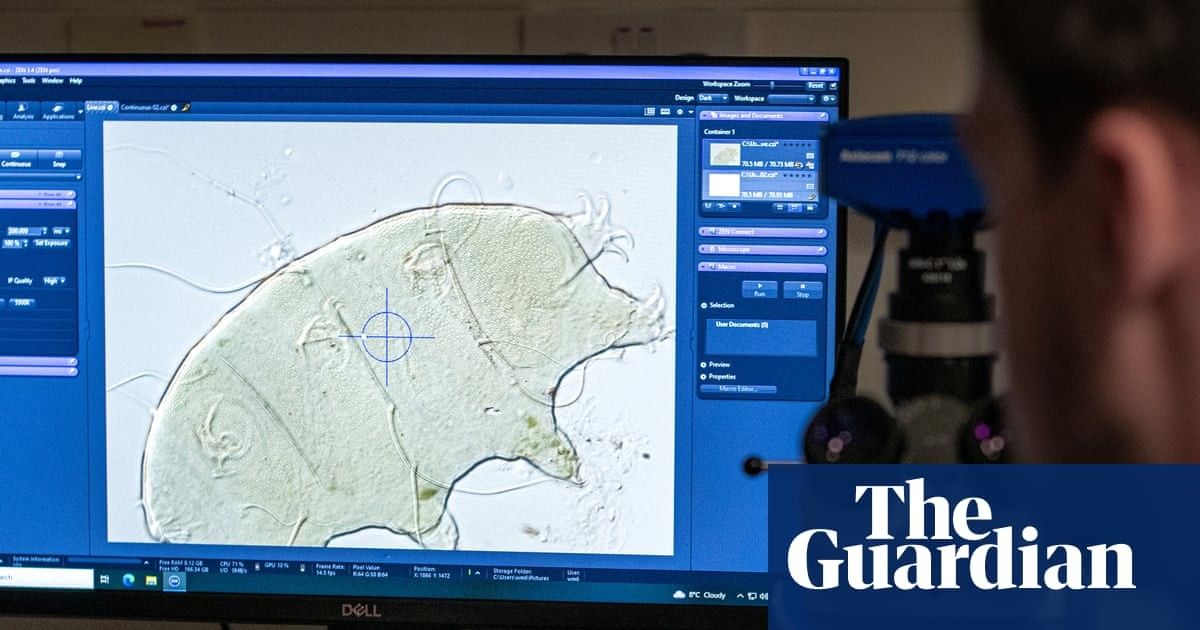
Back in the lab, Morek places the collected moss and lichen into a beaker of water. Within 30 minutes, the tardigrades emerge, wiggling their characteristic chubby legs. Under a microscope, he identifies a translucent specimen about 350 micrometres long – roughly seven times the diameter of a human hair. The creature has recently eaten; its gut contents are visible.
To confirm the species, Morek must examine its eggs. Tardigrade eggs vary in shape – some are smooth, others adorned with mushroom-like or conical protrusions. He makes a temporary slide, placing the tardigrade between glass with water. The slide must be temporary because evaporation could crush the animal. Once identified, the tardigrade is transferred to a barcoded plastic tube and frozen at -71°C in the lab’s double-doored freezers.
The sequencing process begins with DNA extraction. A single tardigrade contains only 200 to 500 picograms of DNA – one picogram is one trillionth of a gram. In the past, researchers had to pool 1,000 tardigrades to get enough material, a method impossible for rare species. The Sanger Institute uses a different approach: the picogram input multimodal sequencing protocol. Genomic DNA and RNA are extracted and separated, then amplified using polymerase chain reaction (PCR). The resulting millions-long strings of bases – adenine, cytosine, guanine, and thymine (ACTG) – are assembled into a genome.
Tardigrade genomes are about 30 times smaller than the human genome, making them easier to sequence and assemble. The Tree of Life programme now sequences 48 genomes per week, a dramatic leap from the early days when Blaxter sequenced 18 genomes over 25 years. To date, the programme has sequenced 2,600 genomes, from whales to fungi, with a focus on British and Irish species.
Superpowers in a Tiny Package: What Tardigrade Genes Could Teach Us
From drought-resistant crops to dry vaccines, the tardigrade’s extreme survival abilities may inspire breakthroughs in biomedicine and biotechnology.
Tardigrades are famous for their near-indestructibility. They can survive searing heat, extreme cold, and even the vacuum of outer space. They achieve this by entering a state of suspended animation, desiccating their bodies and reawakening when water returns. Their abilities include cryobiosis (resistance to freezing), anoxybiosis (survival without oxygen), and anhydrobiosis (repeated desiccation).
By sequencing tardigrade genomes, scientists can pinpoint the genes and proteins responsible for these superpowers. “If a certain protein is crucial in anhydrobiosis, can we use it to produce vaccines which are dry, or add it to crops to make them more drought-resistant?” asks Morek. The potential applications are vast, though still speculative. As he notes, “The more we know, the more questions we are asking. It’s a never-ending story.”
For Blaxter, the broader implications are clear: “Because most of life on this planet is small, like the tardigrades, this new approach to genome sequencing promises to open the gates to sequencing all of life. These genomes will in turn open up new ideas and opportunities in biomedicine and biotechnology.”
Currently, there are four high-quality tardigrade genomes in public databases. Morek is working on 14 more, with approximately 50 species in the freezer awaiting their turn. Each genome helps clarify how tardigrade species are related – some separated by as much as 550 million years of evolution.
The Bigger Picture: Sequencing All Life on Earth
The Tree of Life programme aims to catalogue the genetic blueprint of every species, starting with the tiny and the overlooked.
The tardigrade hunt is one small step in a monumental goal: to sequence the genomes of all life on Earth. This effort, led by the Wellcome Sanger Institute’s Tree of Life programme, seeks to create a reference library of genomes that will transform our understanding of biology, evolution, and medicine.
In 1998, a millimetre-long nematode worm became the first animal to have its whole genome sequenced. The human genome followed in 2003, though it was not fully completed until 2021. Today, sequencing technology has advanced so rapidly that what once took years can now be done in weeks. The programme’s current pace of 48 genomes per week is a testament to these advances.
Yet the scale of the task remains staggering. Vertebrates – humans, dogs, cows, birds, fish – make up barely 5% of animal life on Earth. The vast majority are invertebrates, with at least 1.3 million known species and many more yet to be discovered. By focusing on the tiny and the overlooked, researchers hope to fill critical gaps in the tree of life.
As the 2026 invertebrate of the year competition launches, the tardigrade’s victory from last year highlights the public’s fascination with these resilient creatures. But for scientists like Morek and Blaxter, the real prize is not a contest win – it is the knowledge locked inside each microscopic genome, waiting to be read.
Based on reporting from theguardian.com

