

Image source: dq0hsqwjhea1.cloudfront.net
A Race Against Orbital Decay
Swift’s altitude has dropped dangerously low due to solar activity
NASA has launched an unprecedented mission to rescue the Neil Gehrels Swift Observatory, a key astrophysics workhorse that has been studying gamma-ray bursts and other cosmic phenomena for over two decades. The Lightweight In-space Navigation and Kinematics (LINK) spacecraft lifted off on July 3, 2026, at 4:36 a.m. EDT aboard a Pegasus XL rocket deployed from Northrop Grumman’s L1011 Stargazer aircraft over Kwajalein Atoll in the Marshall Islands. The launch site was chosen to match Swift’s low orbital inclination.
Swift originally orbited at about 600 kilometers (400 miles) after its 2004 launch, but its altitude has decayed to roughly 370 kilometers due to increased atmospheric drag from the current solar cycle’s peak. Without intervention, the observatory would likely reenter Earth’s atmosphere in late 2026. The LINK mission aims to boost Swift to a stable orbit above 550 kilometers, extending its operational life by at least a decade. This marks the first time NASA has attempted an automated, rapid-response rescue of a satellite in space, a maneuver that could set a precedent for future missions to salvage aging spacecraft.
A Daring Rendezvous and Boost
LINK will inspect, dock, and push Swift to a higher orbit
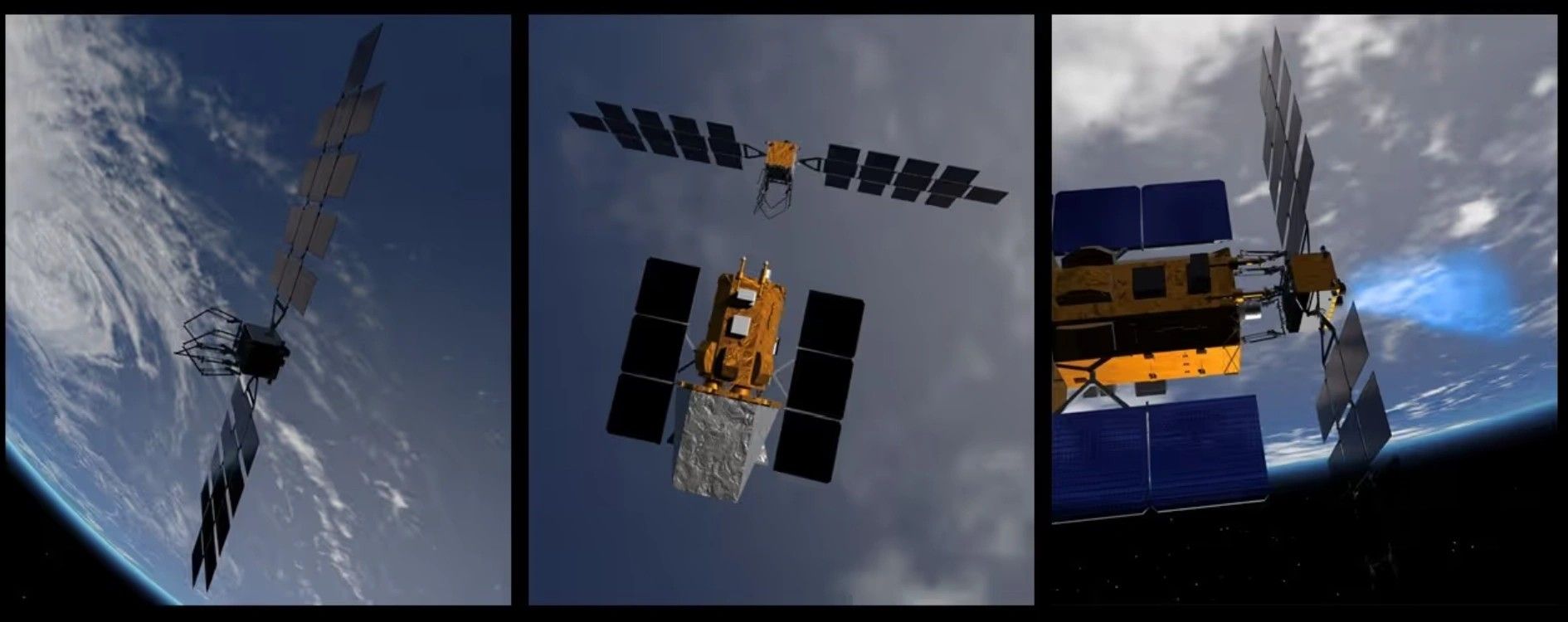
LINK is expected to reach Swift’s vicinity by late July 2026. The spacecraft, roughly the size of a sofa and weighing 400 kilograms (882 pounds), will slowly approach the observatory to inspect it before attempting a physical docking. Swift was never designed for orbital grappling, lacking any built-in retrieval mechanism. Instead, LINK will use laser LIDAR and three parallel manipulators to latch onto flanges on the spacecraft bus originally intended for ground handling.
Once docked, a six-week boost phase will begin. LINK’s three xenon-fueled Hall-effect thrusters will gradually push the stacked spacecraft into a higher orbit, requiring careful balancing to maintain stability. If successful, Swift could resume science operations by fall 2026. Brad Cenko of NASA’s Goddard Space Flight Center noted that boosting Swift above 550 kilometers would give it an orbital lifetime exceeding 10 years, after which hardware failures—such as the already-failing gyroscopes—would likely end its mission. Two of Swift’s four gyroscopes have stopped working; a software patch currently allows operation in two-gyroscope mode.
Swift’s Legacy and the Impact of Its Hiatus
Astronomers feel the loss of a unique rapid-response observatory
Swift has been a linchpin of time-domain and multi-messenger astronomy. Its Burst Alert Telescope (BAT) constantly monitors one-sixth of the sky for high-energy transients like gamma-ray bursts, providing rapid localizations that alert the global astrophysics community. The observatory can then slew to a burst within two minutes, bringing its X-ray and ultraviolet telescopes to bear—a speed unmatched by facilities like the Hubble Space Telescope, which can take days to respond.
Over its 22-year mission, Swift has detected about 100 gamma-ray bursts per year and processed up to five target-of-opportunity requests daily. Its discoveries include GRB 221009A in 2022, the brightest gamma-ray burst ever recorded, dubbed the “BOAT” (Brightest Of All Time). NASA paused Swift’s operations in early 2026 to prepare for the rescue, keeping the spacecraft in an optimal orientation to minimize further decay. Astronomers have already felt the gap: while the Fermi Gamma-ray Space Telescope still monitors the high-energy sky, Swift’s fast-response and afterglow tracking capabilities remain unique. Cenko noted that future missions like the Ultraviolet Explorer (planned for the 2030s) could partially replace Swift’s UV follow-up, but no current NASA plans exist for precise localization of high-energy transients or rapid X-ray response.
A Template for Future Rescues
The mission’s rapid development and execution could inspire similar efforts
The LINK mission was developed in under a year, from design to launch, after NASA awarded $30 million to space startup Katalyst in fall 2025. The spacecraft was assembled at NASA’s Wallops Flight Facility in Virginia and flown to Kwajalein Atoll for launch. This rapid-response capability, combined with the automated docking and boost, could serve as a model for salvaging other valuable satellites in low Earth orbit. Cenko emphasized that Swift’s science productivity would likely end due to hardware failure—such as gyroscope loss or other component wear—more than five years after a successful boost, but such timelines are hard to predict. The mission highlights both the challenges of maintaining aging space assets and the potential for innovative, cost-effective solutions to extend their lives. NASA is expected to broadcast the rendezvous and capture, offering a real-time view of this historic rescue attempt.
Based on reporting from skyandtelescope.org

