

Image source: cdn.mos.cms.futurecdn.net
Close Encounter 62 Million Miles from Earth
Hayabusa2 performs high-speed flyby of asteroid Torifune
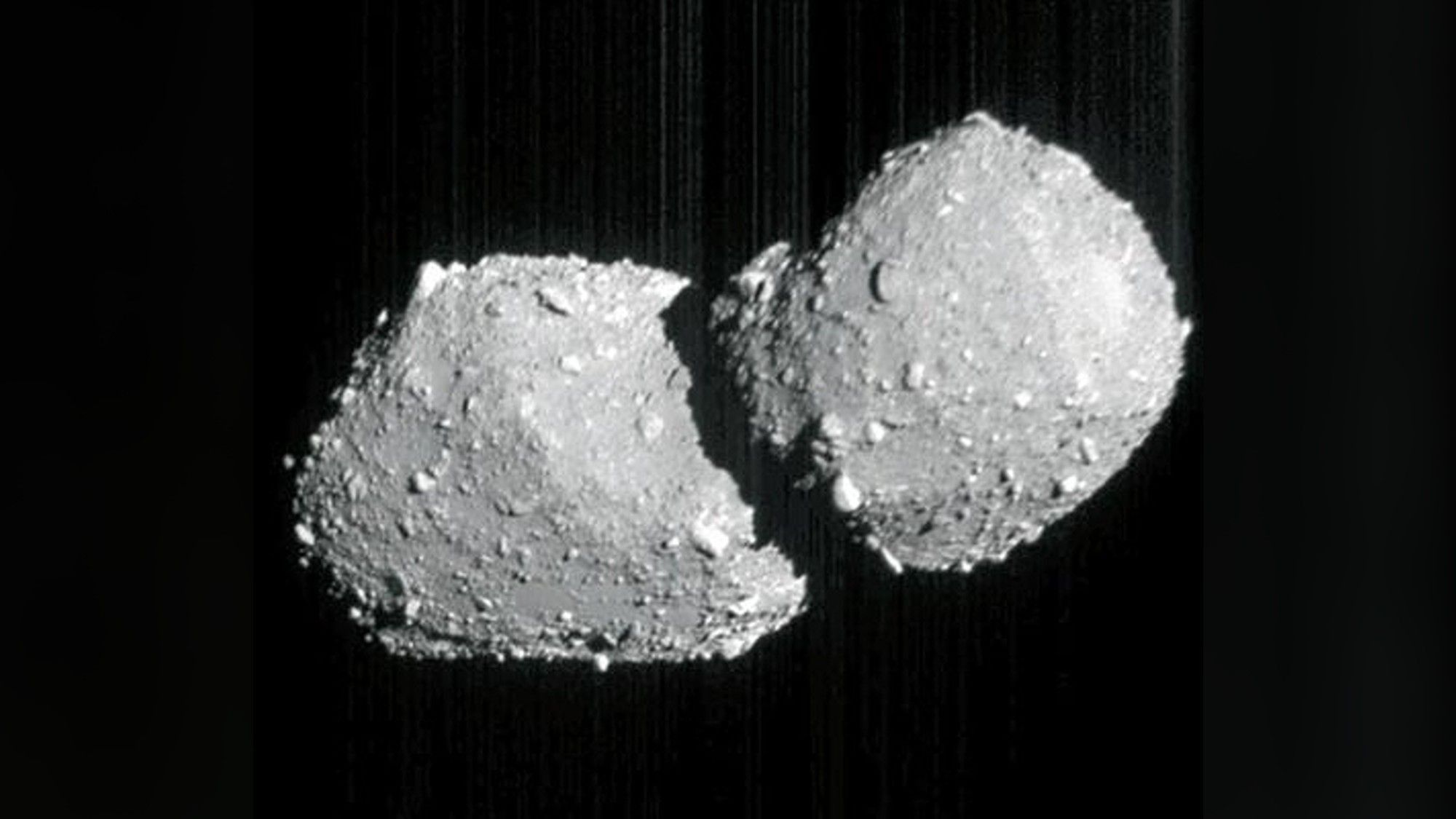
Japan's Hayabusa2 spacecraft, already celebrated for its successful sample-return mission from asteroid Ryugu, has added another milestone to its extended journey. On July 5, the probe performed a close flyby of asteroid Torifune, a double-lobed space rock located approximately 62 million miles (100 million kilometers) from Earth. The Japan Aerospace Exploration Agency (JAXA) confirmed that Hayabusa2 captured remarkable optical and infrared images of the 1,475-foot (450-meter) asteroid during the encounter.
The flyby was described as one of the closest high-speed passes ever attempted with an asteroid, a feat that required precise navigation given the limited prior data on Torifune. The probe's optical camera transmitted a clear image of the two-headed rock, while its Mid-Infrared Camera (TIR) revealed stark temperature contrasts: cooler regions in shadow and warmer areas facing the sun. These measurements will help scientists assess the asteroid's surface properties, including thermal inertia and roughness.
A Risky Operation with Scientific Payoff
Flyby not part of original mission; data still being transmitted
The Torifune flyby was not part of Hayabusa2's initial mission plan. A member of the scientific team previously told Space.com that the maneuver was considered a "risky operation" due to the unknowns surrounding the asteroid's shape, rotation, and debris environment. Despite the challenges, the probe successfully collected additional scientific data during the pass, though JAXA has indicated that those results will be transmitted to Earth at a later date.
Torifune orbits the Sun every 383 days and completes a full rotation every 5 hours. It belongs to the Apollo group of near-Earth asteroids, meaning its orbit crosses Earth's path around the Sun. This classification makes Torifune an object of interest for planetary defense research, as understanding its composition and trajectory could inform future mitigation strategies.
From Ryugu Samples to New Horizons
Hayabusa2's extended mission targets smallest asteroid ever visited
Hayabusa2 launched in December 2014 and achieved its primary goal in December 2020, when JAXA successfully landed samples from asteroid Ryugu in the Australian desert. Those samples have since yielded groundbreaking discoveries, including the detection of all five nucleobases found in DNA and RNA, offering clues about the building blocks of life in the early solar system.
After leaving Ryugu in 2019, the probe embarked on an extended mission with an ultimate destination: asteroid 1998 KY26. This small asteroid, measuring just 36 feet (11 meters) across, is comparable in size to the object that exploded over Chelyabinsk, Russia in 2013. If Hayabusa2 reaches it as planned in 2031, it will become the smallest asteroid ever visited by a spacecraft. The probe is expected to orbit the rock and attempt a touchdown to study its structure and composition, potentially revealing insights about the nature of very small asteroids and their role in the solar system's evolution.
Global Significance and Future Implications
Hayabusa2's journey advances asteroid science and planetary defense
Hayabusa2's continued operations underscore the growing international interest in asteroid exploration. The mission's success with Ryugu demonstrated the feasibility of sample return, while the Torifune flyby showcases the ability to perform high-risk, high-reward encounters with previously uncharacterized objects. Such capabilities are critical for future planetary defense efforts, as understanding the physical properties of near-Earth asteroids is essential for developing deflection strategies.
The data from Torifune, including its double-lobed shape and thermal characteristics, will add to the catalog of known asteroid morphologies. This information helps scientists refine models of how asteroids form and evolve over time. While the full scientific return from the flyby is still pending, the images already captured provide a rare glimpse of a distant world and a testament to the durability of a spacecraft now nearly 12 years into its mission.
Based on reporting from space.com

