

Image source: sciencenews.org
A Staple of Science Parties
Decades-old trick gets a fresh explanation
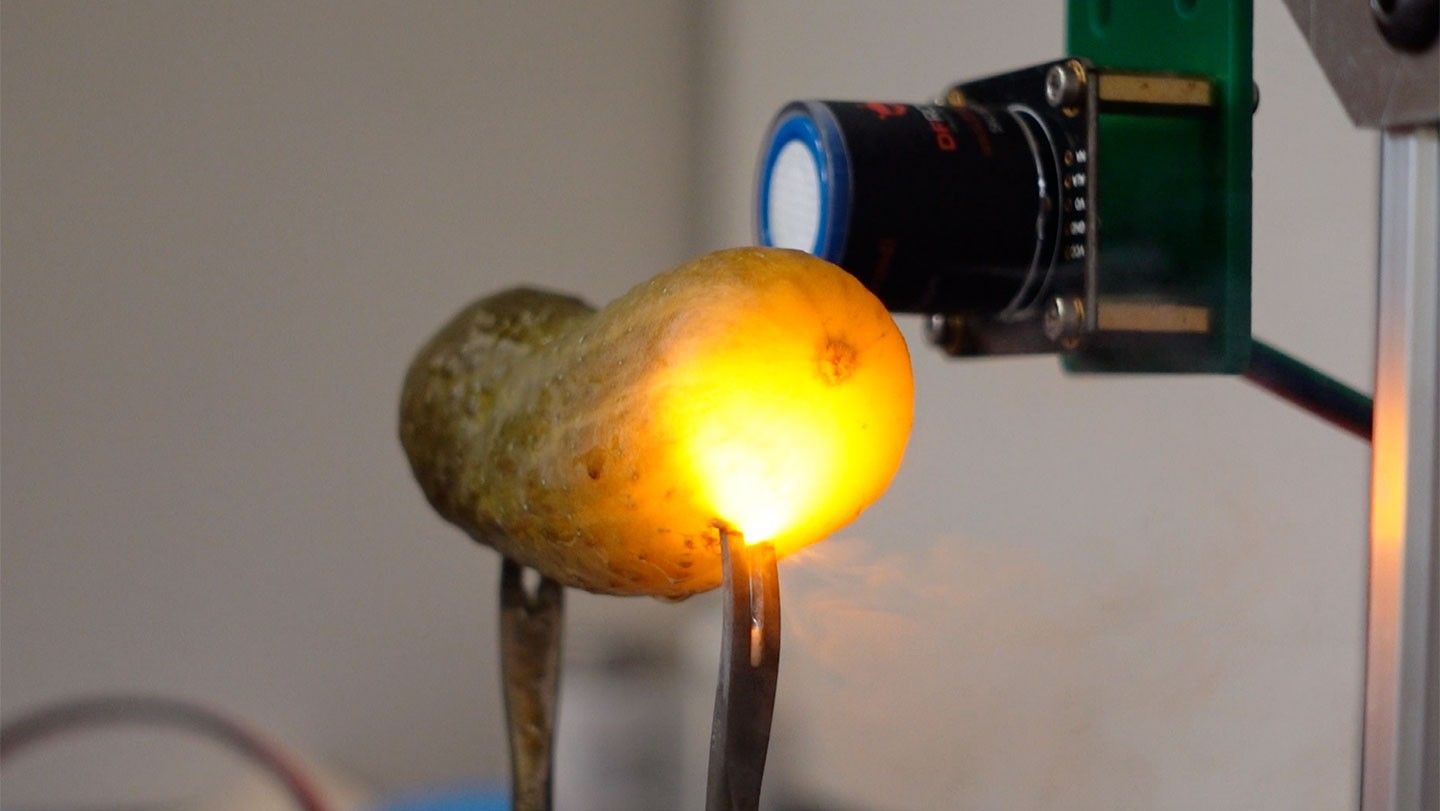
For decades, the glowing pickle has been a staple of science demonstrations and late-night lab parties. When electrodes are inserted into a pickle and connected to a power source, one end of the pickle emits a bright orange glow. While the effect is visually striking, the underlying mechanism has remained a subject of debate among scientists.
Now, researchers at Portland State University in Oregon may have finally unraveled the mystery. In a presentation at the annual meeting of the Electrostatics Society of America on June 16, 2026, electrical engineer Joshua Méndez Harper and his colleague Benjamin Crall shared new experimental evidence that points to a combination of electrolysis and spark-induced combustion as the cause. The work, conducted in a controlled laboratory setting, sheds light on a phenomenon that has entertained and puzzled audiences for years.
How a Pickle Becomes a Conductor
The role of saltwater ions
Pickles are typically soaked in a salty brine, which contains ions—electrically charged atoms. This makes pickles capable of conducting electricity when a voltage is applied. When Méndez Harper skewered a pickle with electrodes and plugged it into a power strip, the pickle sizzled and began to glow at one end, filling the room with the aroma of singed pickle.
Two main theories had previously been proposed to explain the glow. One suggested that the heat from the electrode boils the pickle juice, creating a pocket of vapor that blocks current flow, causing sparks to jump across the gap. The other theory invoked electrolysis, a process where an electric current breaks water into hydrogen and oxygen. The resulting mixture is explosive, and heat from the electrode could trigger small, luminous blasts. The new study suggests both mechanisms are at play.
Alternating Current Is Key
Why direct current fails to produce a glow
To test these ideas, Méndez Harper and his team outfitted a pickle with monitoring equipment, including a high-speed camera and a hydrogen sensor, and applied both alternating current (AC) and direct current (DC). AC, the type from a wall socket, periodically switches the direction of charge flow, while DC provides a steady flow.
The researchers detected hydrogen production in both cases, confirming that electrolysis occurs. However, the glow appeared only with AC. This led the team to propose a dual mechanism: the oscillating nature of AC helps keep the vapor pocket open, allowing sparks to form. These sparks then ignite the hydrogen and oxygen produced by electrolysis, resulting in the glow. In contrast, DC may cause the vapor pocket to collapse, preventing sparks from forming and thus no ignition.
“The oscillating nature of alternating current might help keep the vapor pocket open, allowing sparks to form that ignite the hydrogen and oxygen,” Méndez Harper explained during the talk. The team also addressed why only one end of the pickle glows: it’s the juicier side. When placed vertically, the bottom end, where brine collects, always glows.
Implications and Safety Warnings
A professional experiment not for home replication
While the glowing pickle remains a fascinating scientific party trick, Méndez Harper emphasizes that it should not be attempted at home. “Méndez Harper is a professional — don’t try this at home,” the source notes. The experiment involves high voltage, explosive gases, and fire risk. The researchers disposed of the pickle after the demo; taste tests were not on the menu.
This work not only clarifies a long-standing curiosity but also demonstrates how fundamental physics and chemistry principles interact in everyday objects. Understanding the interplay between electrolysis, vapor pockets, and ignition conditions could have broader applications in studying electrical discharges in moist environments or improving safety in electrolytic processes.
Based on reporting from sciencenews.org

