

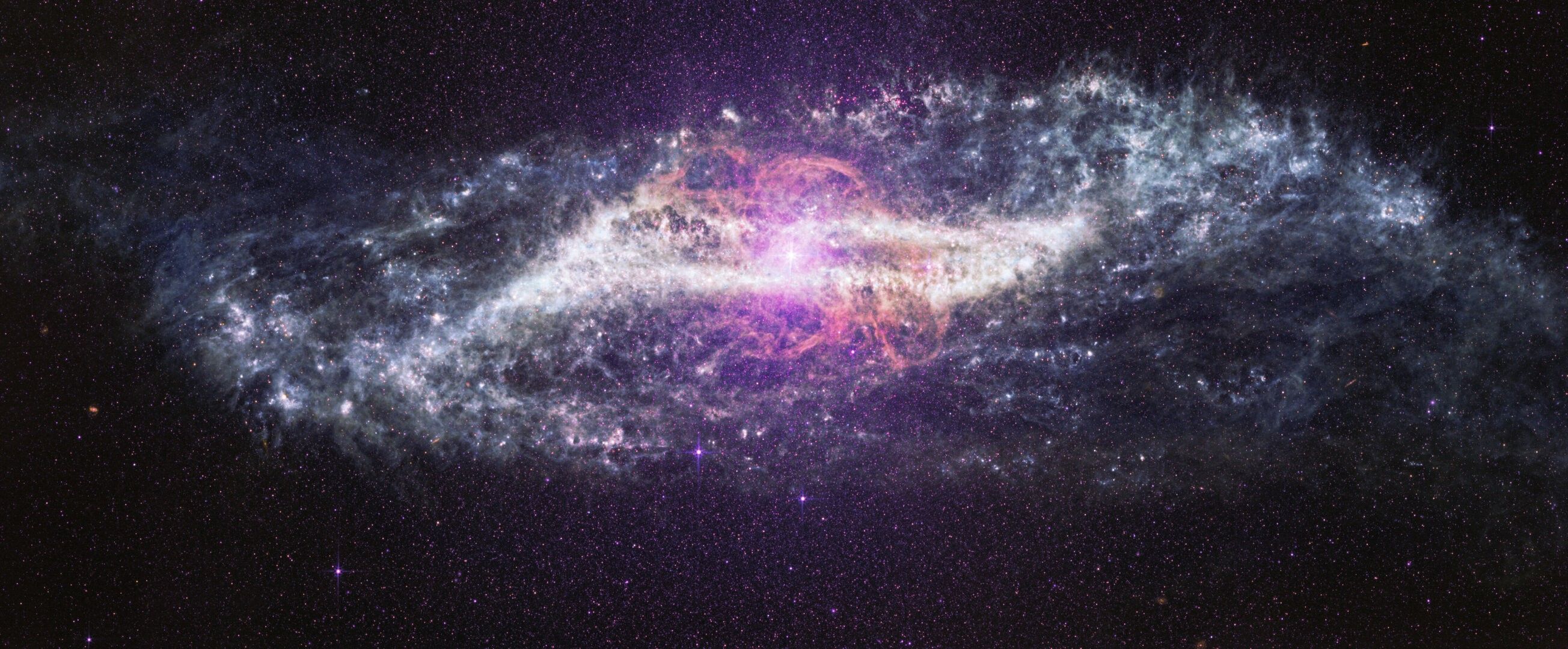
Image source: esa.int
A New View of a Familiar Galaxy
Infrared vision penetrates dust to reveal stellar tapestry
New images from the NASA/ESA/CSA James Webb Space Telescope, released to celebrate its fourth science anniversary, have transformed the familiar galaxy Centaurus A into a far richer and more complex object than ever seen before. Webb’s unprecedented sensitivity across near- and mid-infrared wavelengths cuts through the thick lanes of dust that obscure Centaurus A’s centre in visible light, revealing a densely packed tapestry of individual stars and an active, ever-changing galaxy.
Centaurus A, also known as NGC 5128, lies 11 million light-years from Earth—relatively close in cosmic terms. Unlike most nearby galaxies, it is intensely active, making it a powerful natural laboratory for understanding how galaxies and supermassive black holes grow and evolve together. At its core sits a supermassive black hole that is actively feeding on surrounding material, launching powerful jets and releasing enormous amounts of energy that shape the galaxy around it. The galaxy also bears the scars of a dramatic past: a major collision with another galaxy roughly two billion years ago, whose aftermath is still visible in its unusual structure and ongoing star formation.
Cutting Through the Dust
Webb’s infrared instruments resolve what Hubble could not
Visible-light observations from the NASA/ESA Hubble Space Telescope could not reveal Centaurus A’s central region, where dust blocked the view. NASA’s retired Spitzer Space Telescope showed large-scale structures in the infrared but could not resolve individual stars. Now, Webb brings both clarity and depth, exposing the galaxy’s inner workings star by star.
Webb’s mid-infrared vision highlights the galaxy’s rich dust structures, which glow in intricate shapes that surprise and even perplex astronomers. A warped, parallelogram-like band cuts across the galaxy’s centre, while wisps of material stretch outward like cosmic clouds. An “S”-shaped feature, most notable in the image from Webb’s MIRI (Mid-Infrared Instrument), is unusual and invites questions that need further study. What created this shape? How does the black hole influence it? Is it influenced by merger-induced star formation?
Many of the glowing red points in the MIRI image are dust-rich stars or stellar nurseries, where aging stars shed material back into space or new stars form. This dust is the raw ingredient for future generations of stars and planets, making it central to the ongoing life cycle of the galaxy.
Galactic Archaeology and Black Hole Feedback
Star-by-star analysis reconstructs a timeline of cosmic events
With Webb’s high resolution, astronomers can now study Centaurus A star by star, even in its long-obscured central region. What looks “grainy” in the combined MIRI and NIRCam (Near-Infrared Camera) view is actually a densely packed field of individual stars, each carrying information about the galaxy’s past. This transforms the study of Centaurus A into a case of galactic archaeology: each star revealed helps reconstruct when different events happened—when older stars first formed, when activity slowed down, the burst of star formation during the collision, and stars born from gas stirred in its aftermath. Together, they form a timeline of the galaxy’s evolution.
Webb’s capabilities go beyond imaging. By analysing light with spectroscopy, astronomers can measure how gas moves within the galaxy. Early findings from Webb show fast-moving ionised gas flowing outward, likely driven by the black hole’s activity, and warmer molecular hydrogen in a warped rotating disk near the centre. These observations help explore one of astronomy’s biggest questions: How does a black hole influence an entire galaxy? The answer appears to be complex. The black hole can trigger star formation by compressing gas, but also limit it by pushing material away. Centaurus A offers a rare, nearby view of this cosmic interplay.
Four Years of Groundbreaking Science
Webb’s fourth year delivers discoveries from across the universe
The fourth year of Webb’s science operations has delivered further groundbreaking discoveries from across the Universe. Astronomers found new evidence for a planet orbiting Alpha Centauri, just four light-years away from our Sun. Webb showcased eight spectacular gravitational lenses out of an in-depth survey that identified hundreds of candidates. By looking into the cradles of star clusters in nearby galaxies, scientists found that more massive clusters emerge faster. Meanwhile, in our own Solar System, Webb mapped the upper atmosphere and auroras of Uranus.
In the early Universe, Webb revealed a black hole that formed before its galaxy did, providing new evidence for how supermassive black holes originated, and identified a supernova occurring just 730 million years after the Big Bang—the earliest to date. Researchers presented the strongest evidence yet that some of the “little red dots” discovered by Webb in 2022 are rapidly growing black holes enveloped in dense gas cocoons. Webb also took a fresh look at the Hubble Ultra Deep Field, resulting in a new view that reveals thousands of distant galaxies dating back to the earliest periods of cosmic history.
Among the unique images produced by Webb over the last year were the gossamer nebulae around a planet-forming disc, intricate details in the edge of the Helix Nebula, the complex heart of a cosmic butterfly, and young stars across every stage of formation. Webb highlighted a beacon of light in the swirls of galaxy Messier 77 and details of the stellar lifecycle in galaxy NGC 5134. Webb and Hubble also joined forces to share the most comprehensive view of Saturn to date, showing layers and storms in its atmosphere.
Webb is the largest, most powerful telescope ever launched into space. Under an international collaboration agreement, ESA provided the telescope’s launch service, using the Ariane 5 launch vehicle. Working with partners, ESA was responsible for the development and qualification of Ariane 5 adaptations for the Webb mission and for the procurement of the launch service by Arianespace. ESA also provided the workhorse spectrograph NIRSpec and 50% of the mid-infrared instrument MIRI, which was designed and built by a consortium of nationally funded European Institutes in partnership with JPL and the University of Arizona.
Based on reporting from esa.int

