

Webb Telescope Uncovers Ravenous Black Hole from Cosmic Dawn

📷 Image source: cdn.mos.cms.futurecdn.net
Cosmic Dawn Revelation
Ancient Black Hole Challenges Galactic Evolution Theories
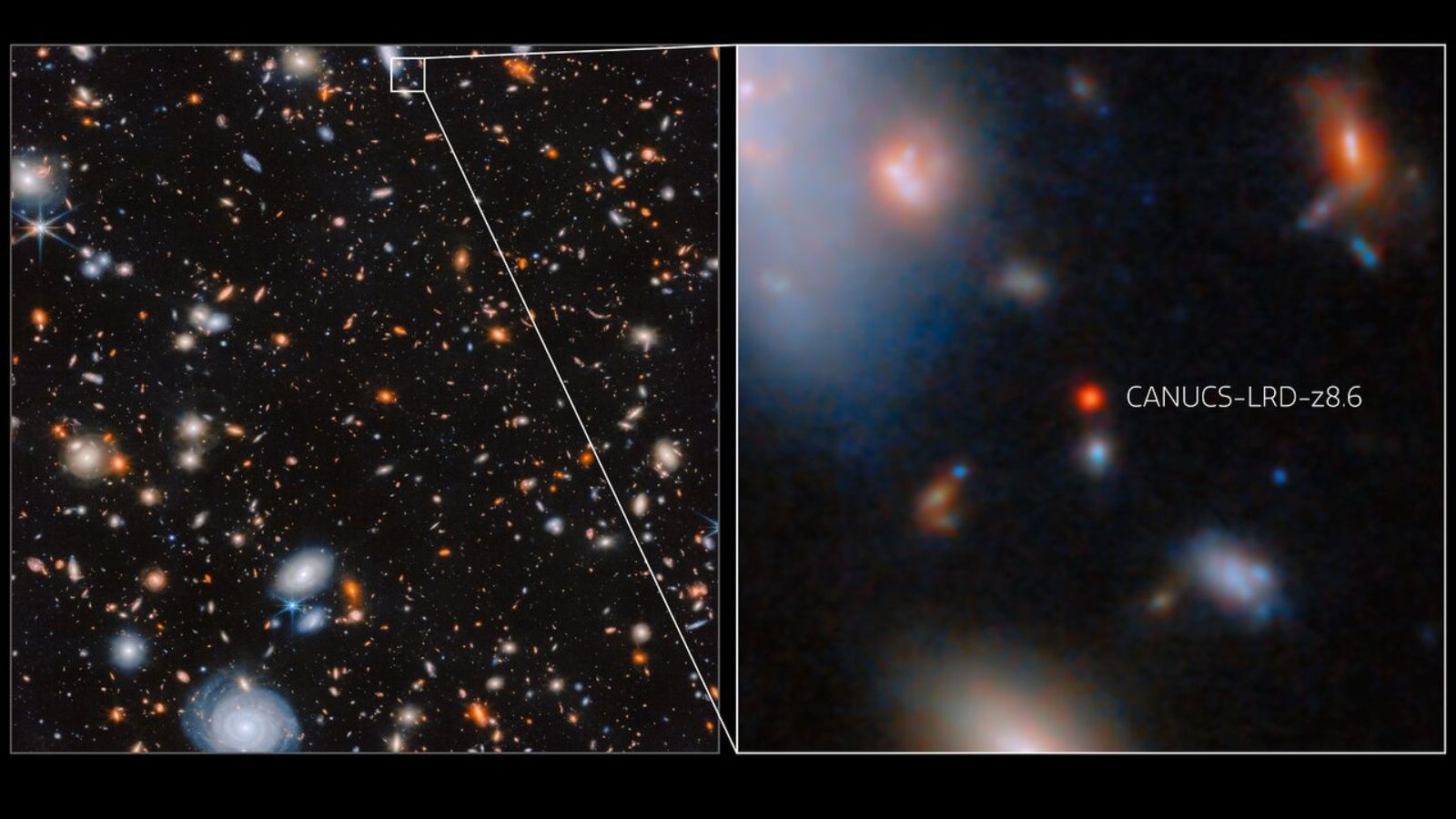
The James Webb Space Telescope has detected a supermassive black hole actively consuming matter just 400 million years after the Big Bang, according to space.com. This discovery, dated November 20, 2025, reveals a cosmic entity growing at unprecedented rates during the universe's infancy, challenging existing models of how such massive objects form so quickly after cosmic dawn.
The finding represents one of the earliest confirmed supermassive black holes ever observed, existing when the universe was merely 3% of its current age. Astronomers describe this detection as fundamentally altering our understanding of cosmic evolution timelines. The black hole's rapid growth rate suggests formation mechanisms that current astrophysical models cannot fully explain, pointing to potential gaps in our knowledge of early universe physics.
Technical Breakthrough
How Webb's Instruments Captured the Impossible
Webb's Near-Infrared Spectrograph (NIRSpec) instrument played the crucial role in identifying this distant black hole through detailed spectral analysis. The telescope detected specific light signatures indicating intense gas accretion around the black hole, with matter falling into the gravitational well at extraordinary velocities. This spectral data revealed the black hole's composition, mass estimates, and feeding behavior with precision previously impossible for objects at such cosmic distances.
The observation required Webb's unprecedented infrared sensitivity because the expansion of the universe has stretched the light from this ancient object into infrared wavelengths. Ground-based telescopes cannot detect these signals due to atmospheric interference, while previous space telescopes lacked the necessary resolution and sensitivity. Webb's 6.5-meter primary mirror and cryogenic cooling system enabled the detailed measurements that made this discovery possible.
Feeding Frenzy Metrics
Quantifying the Black Hole's Extraordinary Appetite
The supermassive black hole exhibits an accretion rate—the speed at which it consumes surrounding matter—that challenges theoretical maximums. According to space.com data, it's devouring material at nearly the Eddington limit, the maximum sustainable rate before radiation pressure would theoretically blow away the surrounding gas and dust that fuel its growth. This sustained high-rate consumption explains how the object reached such massive proportions so early in cosmic history.
Mass estimates place this black hole at several million times the mass of our Sun, extraordinary for such a young cosmic era. For comparison, the supermassive black hole at the center of our Milky Way, Sagittarius A*, took billions of years longer to reach a similar mass range. The rapid growth suggests either exceptionally efficient feeding mechanisms or potentially different formation pathways than those observed in later cosmic epochs.
Galactic Context
The Host Galaxy's Surprising Characteristics
The black hole resides within a host galaxy that shows unexpected maturity for its cosmic age. Observations indicate significant stellar populations and complex structures typically associated with more evolved galactic systems. This presents a paradox: how did both the galaxy and its central black hole develop such advanced characteristics in such a brief cosmic timeframe? The co-evolution appears to have occurred at accelerated rates compared to later galactic development patterns.
Gas dynamics within the host galaxy show unusual patterns, with material flowing toward the central black hole at efficiencies that exceed typical galactic feeding mechanisms. The galaxy itself appears compact yet massive, containing stellar populations that suggest rapid, early star formation episodes. This challenges models that predict more gradual galactic maturation processes in the early universe.
Theoretical Implications
Challenging Black Hole Formation Models
This discovery directly confronts several leading theories about early supermassive black hole formation. The direct collapse model, which proposes that massive gas clouds could collapse directly into black holes without forming stars first, gains support from these observations. However, the rapid growth to supermassive proportions remains difficult to explain through conventional accretion physics alone, suggesting either enhanced feeding mechanisms or additional mass acquisition pathways.
Alternative formation scenarios involving primordial black holes—hypothetical black holes formed in the early universe's dense conditions—face new constraints from this observation. The specific mass and accretion characteristics provide testable parameters for models proposing that some supermassive black holes might have originated from these primordial seeds rather than stellar collapse remnants.
Cosmic Timeline Impact
Rewriting Early Universe Evolution
The existence of such a massive, actively feeding black hole just 400 million years after the Big Bang compresses the timeline for cosmic structure formation. Previous models suggested that supermassive black holes required longer periods to accumulate their mass through gradual accretion and mergers. This discovery indicates that the processes governing early cosmic evolution operated at accelerated rates, potentially driven by different physical conditions in the denser, hotter early universe.
Reionization—the process that cleared the cosmic fog of neutral hydrogen—may have been influenced by such early active black holes. Their intense radiation could have contributed to reheating the intergalactic medium, affecting galaxy formation rates across cosmic volumes. The timing of this black hole's activity coincides with the later stages of cosmic reionization, suggesting potential connections between early black hole growth and large-scale cosmic transformation.
Observational Challenges
Technical Limitations and Future Possibilities
Detecting such distant black holes presents extraordinary technical challenges due to their extreme faintness and cosmic redshift. Webb's capabilities represent a significant advancement, but even this powerful telescope operates near detection limits for objects at such distances. The observations required hundreds of hours of exposure time and sophisticated data processing techniques to extract the faint signals from background noise and instrumental effects.
Future observatories, including planned thirty-meter class ground-based telescopes and next-generation space telescopes, will build upon these findings. These advanced instruments will enable detailed studies of the black hole's immediate environment, potentially revealing the dynamics of gas inflow and outflow processes. They may also detect similar objects at even earlier cosmic epochs, testing the limits of how quickly supermassive black holes can form after the Big Bang.
Comparative Analysis
Contextualizing Within Known Black Hole Populations
This newly discovered black hole occupies an extreme position in the mass-redshift parameter space, representing both high mass and early formation time compared to most known supermassive black holes. When plotted against cosmic time, it appears as an outlier that challenges smooth evolutionary trends. Statistical analyses suggest that if this object is representative of a population rather than a rare exception, then current census estimates of early universe black holes require significant upward revision.
The black hole's properties show similarities to later-era quasars—extremely luminous active galactic nuclei—but at much earlier cosmic times. This continuity suggests that the physical processes powering these cosmic engines remain consistent across cosmic history, though operating under different environmental conditions. The main distinction appears to be the accelerated timeline rather than fundamentally different mechanisms.
Formation Scenarios
Examining Possible Birth Mechanisms
Several formation pathways could potentially explain this black hole's rapid growth. The direct collapse scenario involves massive primordial gas clouds collapsing under gravity without fragmenting into stars first, potentially forming black holes with initial masses of thousands of solar masses. These heavy seeds would then grow more rapidly than stellar-mass black holes, potentially reaching supermassive status within a few hundred million years through efficient accretion.
Alternative mechanisms include rapid growth through sustained super-Eddington accretion, though current models struggle to maintain such rates for extended periods. Merger scenarios involving multiple smaller black holes face timing challenges within the compressed cosmic timeline. The detection provides crucial constraints for numerical simulations attempting to reproduce early universe black hole formation, with most current models underestimating the rapid growth rates observed.
Research Methodology
The Scientific Process Behind the Discovery
The discovery resulted from Webb's Cosmic Evolution Early Release Science (CEERS) survey, which targets specific cosmic fields with deep multi-wavelength observations. Researchers employed spectral energy distribution fitting techniques to distinguish the black hole's emission from its host galaxy's starlight. The key identifying feature was the broad emission lines in the infrared spectrum, characteristic of gas moving at high velocities in the black hole's gravitational field.
Confirmation required multiple verification steps, including comparison with known spectral templates and exclusion of alternative explanations like unusual star formation regions. The research team utilized multiple Webb observing modes to cross-validate their findings, ensuring the detection represented a genuine distant black hole rather than instrumental artifacts or foreground contamination. Independent analysis by separate research groups will be necessary for full scientific validation.
Future Investigations
Unanswered Questions and Research Directions
This discovery opens numerous research avenues requiring follow-up observations. Determining whether this object represents a common population or a rare outlier stands as a primary question. Additional Webb observations of similar cosmic epochs will establish statistical occurrence rates, while deeper observations may reveal even earlier examples. The relationship between early black hole growth and host galaxy development requires detailed investigation to understand potential feedback mechanisms.
The chemical enrichment history around this black hole presents another compelling research direction. Early metal production from first-generation stars might have influenced accretion efficiency through changed cooling rates in surrounding gas. Future spectroscopic observations could detect metal lines that reveal the chemical environment and potentially identify population III star signatures in the host galaxy, connecting black hole growth to the first stellar generations.
Perspektif Pembaca
How do you think the discovery of such early supermassive black holes should influence our search for extraterrestrial intelligence? Considering these findings, should we adjust our assumptions about cosmic timelines for the development of complex life in the universe?
Share your perspective on whether accelerated cosmic evolution makes intelligent life more or less likely to emerge at various cosmic epochs. How might the presence of such massive, early black holes influence planetary system formation and stability in their host galaxies?
#WebbTelescope #BlackHole #CosmicDawn #Astronomy #SpaceDiscovery


