

Europa's 'Spiders': Windows into an Alien Ocean and the Hunt for Life

📷 Image source: earthsky.org
Introduction: An Icy Moon's Cryptic Markings
Beyond the Familiar Craters
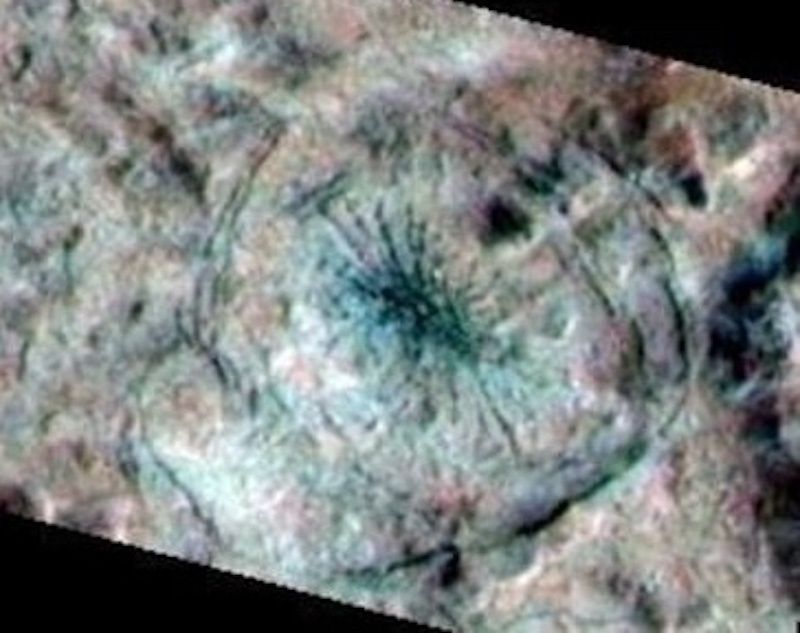
When scientists peer at Europa, Jupiter's fourth-largest moon, they are not looking at a dead, cratered world. Instead, they see a cracked and streaked icy shell, a global puzzle hiding a vast liquid water ocean beneath. Among the most perplexing features on this alien landscape are formations nicknamed 'spiders' for their uncanny multi-legged appearance.
These are not arachnids, of course, but geological structures that may serve as direct conduits to the ocean below. According to earthsky.org, published on 2025-12-27T11:13:15+00:00, new analysis suggests these spiders could be surface expressions of briny water lurking relatively close to the surface. This places them at the forefront of astrobiological investigation for future missions.
What Exactly Are Europa's 'Spiders'?
Defining a Unique Geological Phenomenon
Formally termed 'araneiforms'—from the Latin for 'spider-like'—these features consist of a central depression or fracture from which a complex network of cracks radiates outward, sometimes spanning tens of kilometers. The legs are not raised ridges but rather darker, linear troughs etched into the bright ice. Their formation is fundamentally different from impact craters or tectonic ridges seen elsewhere in the solar system.
The leading hypothesis, supported by data from missions like Galileo, is that spiders are created by the interaction of liquid or slushy water with the overlying ice shell. The process is thought to involve pressurised brine from below forcing its way upward, fracturing the ice in a distinctive pattern. This makes them potential markers for subsurface liquid, a critical factor in the search for habitable environments.
The Brine Connection: From Ocean to Surface
How Liquids Might Travel Through the Ice
Europa's subsurface ocean is estimated to be global, containing more than twice the volume of all Earth's oceans combined. However, this ocean is buried under an ice shell estimated to be 15 to 25 kilometers (9 to 16 miles) thick. The central question is how material, and potential biosignatures, from this ocean could ever reach the surface where spacecraft can sample it. Spiders may provide one answer.
The new analysis highlighted by earthsky.org suggests that brines—salty water that remains liquid at far lower temperatures than pure water—could migrate upward through the ice. These brines might not originate from the deep ocean itself but from smaller, shallower reservoirs within the ice shell. As they move and refreeze, they create stress and fracture patterns, ultimately manifesting as the spider features we observe from orbit.
A Comparative Geological Lens: Earth and Mars
Understanding Through Terrestrial Analogues
To comprehend processes on an ice world 630 million kilometers (390 million miles) away, scientists often look to Earth. Potential analogues for Europa's spiders might be found in certain patterned ground formations in polar regions or in the formation of 'basaltic spiders' on Mars. On Mars, seasonal carbon dioxide ice sublimates (turns directly from solid to gas) from beneath a slab, jetting dark material onto the surface in spider-like patterns.
However, the mechanism on Europa is fundamentally driven by liquid water, not sublimating gas. This key difference underscores the unique and potentially water-rich nature of the Jovian moon. Studying these differences helps refine models of how fluids behave under low-gravity, low-temperature, and high-radiation conditions, informing what future landers or penetrators might encounter.
The Technical Mechanism: A Step-by-Step Hypothesis
How a Spider Might Be Born
The proposed formation sequence is a complex dance of physics. It likely begins with a pocket of brine trapped within the ice shell, warmed by Europa's internal tidal heating. As this pocket migrates or expands, it increases pressure on the surrounding ice. Eventually, the overlying ice fractures, creating the central 'body' of the spider.
The brine then propagates laterally along weaker layers or pre-existing fractures, extending the network of 'legs.' As it does so, it may deposit darker salts and organic compounds—if they exist—onto the surface, explaining the features' low albedo. The process may be episodic, occurring over thousands of years, with each reactivation potentially adding to the complex pattern.
Implications for Astrobiology: A Shorter Path for Life
Why Proximity to the Surface Matters
The potential existence of brines closer to Europa's surface is a game-changer for the search for life. If the ocean is the primary habitable zone, a 20-kilometer (12-mile) thick ice shell is a formidable barrier for both ascending chemicals and descending probes. Shallow brines significantly shorten that distance.
These near-surface reservoirs could act as mixing chambers, where ocean-derived nutrients, oxidants from the surface ice, and internal heat converge. According to the earthsky.org report, this creates 'potentially habitable niches' independent of the deep ocean. If life exists in Europa's ocean, evidence of it—in the form of chemical fossils or even dormant cells—could be transported and concentrated in these spider-associated brines, making them prime sampling targets.
Risks and Limitations of the Current Understanding
The Gaps in Our Knowledge
It is crucial to explicitly note the uncertainties. The spider-brine connection remains a compelling hypothesis based on remote sensing data, primarily from the 1990s Galileo mission. Scientists lack direct, in-situ confirmation of the composition of these features. The exact depth of the proposed brine reservoirs, their salinity, and how interconnected they are remain unknown.
Furthermore, Europa's surface is bathed in intense radiation from Jupiter's magnetosphere, which could rapidly degrade complex organic molecules. This poses a risk: biosignatures sampled at the surface may be heavily altered or destroyed. It also presents a technical challenge for mission longevity. The uncertainty underscores why future missions are designed not just to orbit, but to directly analyse surface material.
The International Mission Landscape: Eyes on Europa
From Galileo to JUICE and Europa Clipper
Our knowledge of spiders stems from NASA's Galileo orbiter, which ended its mission in 2003. The torch is now passing to a new generation of spacecraft. The European Space Agency's Jupiter Icy Moons Explorer (JUICE), launched in 2023, will perform multiple flybys of Europa, using more advanced instruments to map its surface composition and subsurface structure in greater detail.
NASA's flagship Europa Clipper mission, scheduled for launch in the coming years, is specifically designed to investigate the moon's habitability. Its suite of instruments will measure the ice shell thickness, search for subsurface lakes, and analyse the composition of surface plumes and features like spiders with unprecedented resolution. These missions represent a global, collaborative effort in astrobiology, with the shared goal of characterising potentially habitable worlds.
The Sampling Challenge: Future Surface Missions
How We Might Touch a Spider
Orbiters like Clipper will identify the most promising locations, but the definitive search for life likely requires landing. Proposals for a Europa lander envision a spacecraft touching down near a feature like a spider or a region where material from below has been emplaced. It would then use a drill or a penetrator to access the ice, potentially reaching briny layers just below the surface.
The engineering challenges are immense: achieving a safe landing on unknown terrain, operating in extreme radiation, and maintaining sterile sampling protocols to prevent contamination while searching for indigenous life. The scientific payoff, however—the potential to answer whether we are alone in the solar system—drives the technological innovation required for such an endeavour.
Broader Impact: Rethinking Habitability in the Solar System
Europa's Lesson for Enceladus and Beyond
Europa is not an isolated case. Saturn's moon Enceladus also possesses a subsurface ocean and jets material from fissures into space, which has been sampled by the Cassini spacecraft. The study of Europa's spiders informs the search for similar features on other icy worlds, such as Ganymede or even distant Pluto. It establishes a geological paradigm where surface features act as diagnostic tools for subsurface conditions.
This shifts the focus of planetary exploration. Worlds once considered frozen, inert marbles are now seen as dynamic, potentially habitable systems where geology and biology may interact. The discovery and study of features like spiders underscore that habitability requires a nuanced understanding of chemistry, heat, water, and geological processes operating together over cosmic time.
Perspektif Pembaca
The exploration of Europa sits at the intersection of profound scientific curiosity, immense technological challenge, and a fundamental human question. As we prepare to scrutinise its icy shell in unprecedented detail, the ethical and philosophical dimensions of the search come into focus.
What responsibility do we have to protect a potential alien biosphere from Earthly contamination, and how do we balance that with the aggressive sampling needed to detect it? If evidence of life, even in microbial form, is one day found in the briny fractures of a Europan 'spider,' how should that discovery be communicated and contextualised for a global public? Share your perspective on which priority should guide this next great exploration: absolute caution or the imperative to seek an answer.
#Europa #Astrobiology #SpaceExploration #Jupiter #OceanWorlds


