

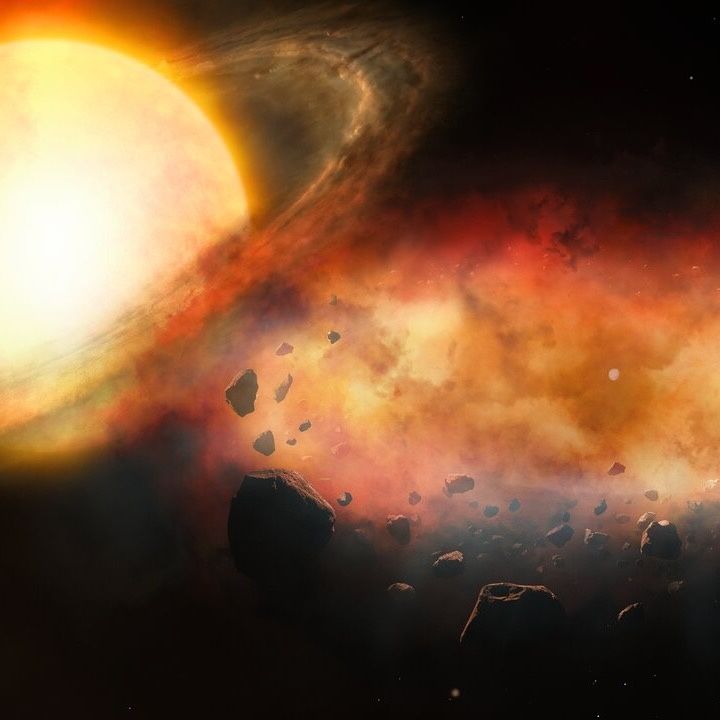
A Cosmic Enigma: The Mysterious Object Hidden Within a Colossal Gas Cloud

📷 Image source: earthsky.org
A Galactic Anomaly Revealed
Astronomers peer into a vast cloud to find something unexpected
In the depths of space, a colossal cloud of gas and dust known as IRAS 23077+6707 has presented astronomers with a profound mystery. According to earthsky.org, observations have revealed a compact, massive object lurking at its heart, an enigma that defies easy classification. This discovery, reported on January 23, 2026, challenges existing models of celestial formation and evolution.
The giant cloud itself, which appears to be a young version of the ring-like structures seen around some older stars, stretches across hundreds of billions of kilometers. Yet, its sheer scale is overshadowed by the puzzle within. What exactly is this dense, hidden entity? The possibilities range from a nascent planetary system to something far more exotic, but current data refuses to yield a definitive answer.
The Telltale Signature of Something Massive
How astronomers detected the unseen
The discovery hinges on the object's gravitational influence. While the object itself remains shrouded, its presence is betrayed by the motion of the surrounding gas and dust. According to the report from earthsky.org, astronomers observed the cloud using advanced radio telescopes, which allowed them to map the velocities of material within it.
They found a clear, swirling pattern—a signature of rotation—centered on a specific point. This kinematic evidence strongly suggests a compact, massive body is acting as a gravitational anchor, orchestrating the dance of the cloud from within. The mass of this central object is estimated to be several times that of our own sun, yet it occupies a region of space far smaller than the expansive cloud it dominates.
A Young Stellar Object or a Binary Star in Hiding?
Weighing the leading astronomical hypotheses
So, what could it be? The report outlines several plausible theories, each with its own implications. One strong candidate is a Young Stellar Object (YSO), a star in its earliest, most formative stages. In this scenario, IRAS 23077+6707 would represent the circumstellar disk and envelope from which the proto-star is actively feeding, a cosmic nursery caught in a specific, fleeting phase of development.
Another compelling possibility is that the cloud harbors not one, but two stars—a binary system. The complex dynamics of two stars orbiting each other within a shared gaseous envelope could explain the observed structure and motions. Distinguishing between a single YSO and a binary pair requires more precise data, as both can create similar observational footprints at this distance and stage of evolution.
The Challenge of Classification
Why this object doesn't fit neatly into known categories
The mystery deepens when trying to pigeonhole IRAS 23077+6707 into established astronomical catalogs. It shares characteristics with known classes of objects but is not a perfect match for any. This ambiguity is central to its scientific value. As the earthsky.org report indicates, it may represent a rare or short-lived phase in the life cycle of stars, a phase that astronomers have seldom witnessed with such clarity.
The cloud's large, seemingly symmetrical structure is particularly puzzling. It evokes images of protoplanetary disks seen around younger stars, yet the suspected central object's mass suggests a more advanced evolutionary stage. This disconnect forces researchers to question whether they are seeing a standard process from an unusual angle or an entirely novel astrophysical phenomenon.
The Tools of Discovery
Peering through the cosmic veil with radio waves
Unraveling this mystery was made possible by facilities like the Submillimeter Array (SMA) on Maunakea, Hawaii. Radio and submillimeter wavelength observations are uniquely suited for this task, as they can penetrate the thick veils of dust that obscure visible light. These telescopes effectively 'see' the thermal glow of cold dust and the spectral fingerprints of molecules within the cloud.
By analyzing the subtle shifts in the frequency of light emitted by specific molecules—a phenomenon known as the Doppler effect—astronomers could create a detailed velocity map. This map is the direct evidence for the central mass. Without this technology, the giant cloud might have been cataloged as a simple nebula, its hidden heart remaining a secret.
Implications for Star and Planet Formation
What a hidden massive object teaches us about cosmic beginnings
The study of IRAS 23077+6707 is more than an exercise in celestial classification; it probes the fundamental processes that build stars and planets. If the central object is a young star, its relationship with the enormous cloud offers a rare snapshot of how a star interacts with and shapes its natal environment during a critical growth phase. How does it draw material inward? How does its energy output affect the chemistry of the surrounding disk?
If it is a binary, it provides a case study in how multiple stars can form and evolve within a common envelope, a process that may influence the ultimate architecture of planetary systems. The sheer size of the cloud suggests the potential for a vast reservoir of material, raising questions about what kind of planetary system, if any, could eventually emerge from such an expansive cradle.
The Path to Unlocking the Mystery
Future observations that could provide answers
Resolving the nature of the central object will require a multi-wavelength assault. Astronomers will likely turn to even more powerful radio interferometers, such as the Atacama Large Millimeter/submillimeter Array (ALMA) in Chile. ALMA's superior resolution and sensitivity could potentially tease apart the very center of the cloud, revealing finer details of the structure and potentially detecting emission directly from the obscured object.
Additional observations in infrared light may also help, as some wavelengths can pierce the dust more effectively than others. The goal is to build a composite, three-dimensional picture of the cloud's density, temperature, and velocity structure. Each new data point will constrain the theoretical models, gradually eliminating possibilities until only the true explanation remains.
A Reminder of the Universe's Complexity
Why cosmic mysteries like this matter
Discoveries like the object in IRAS 23077+6707 serve as a powerful reminder that the universe is still full of surprises. For every well-defined category in astronomy textbooks, there exist borderline cases and outright anomalies that challenge our understanding. These objects are not mere curiosities; they are the stress tests for our scientific theories.
They force astronomers to ask new questions, refine their models, and develop more sophisticated observation techniques. The ultimate identification of this hidden mass—whether a budding star, a stellar duo, or something else—will add a crucial piece to the grand puzzle of how cosmic structures evolve. For now, it stands as a compelling testament to the fact that much of the universe's drama unfolds hidden from plain view, waiting for the right tools and the persistent curiosity to bring it to light.
#Space #Astronomy #ScienceNews #CosmicMystery


