

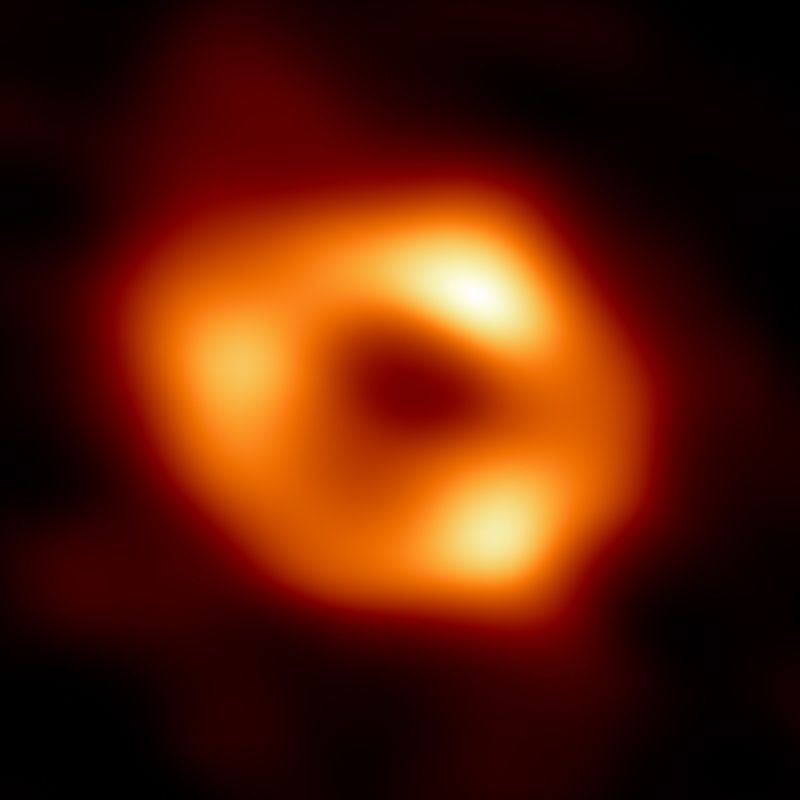
A Sleeping Giant Awoke: Our Galaxy's Core Flared in Living Memory

📷 Image source: earthsky.org
Introduction: A Quiet Monster's Recent Roar
For centuries, the supermassive black hole at the heart of our Milky Way galaxy, known as Sagittarius A* (pronounced "Sagittarius A-star"), has been considered a relatively quiet and well-behaved cosmic giant. Observations suggested it was a dormant engine, consuming little material and emitting minimal energy. This perception of celestial tranquility has been fundamentally challenged by new findings.
According to research detailed on earthsky.org on 2026-01-22T11:38:11+00:00, this sleeping monster erupted in a significant outburst not in the distant past, but surprisingly recently. The evidence suggests a powerful flare-up occurred within the last few hundred years, a mere blink in cosmic time. This discovery forces astronomers to reconsider the behavior and impact of our galaxy's central engine on its surrounding environment.
The Smoking Gun: A Glowing Gas Cloud
Tracing the Echoes of Light
The key evidence for this recent eruption comes not from observing the black hole directly, but from studying its effects on a neighboring cloud of gas and dust. This cloud, known as the molecular cloud Sgr A East, is located roughly 200 light-years from the galactic center. Researchers found that this cloud is glowing brightly in X-ray light, a phenomenon that requires a powerful source of energy to excite it.
The most logical explanation, according to the earthsky.org report, is that the cloud is being illuminated by an echo or reflection of a past, intense X-ray flare from Sagittarius A*. The light from that flare traveled to the cloud, was absorbed, and is now being re-emitted, allowing scientists to effectively look back in time. The intensity and spectrum of this glow act as a fossil record of the black hole's past activity.
Timing the Blast: Centuries, Not Millennia
A Recent Event in Human History
Determining *when* this eruption happened is a complex puzzle of light travel times and cloud geometry. By analyzing how the X-ray light propagates and reflects, scientists have placed tight constraints on the timing of the original flare. The data indicates the outburst occurred within the last few hundred years, potentially as recently as the late 19th century.
This timeframe is astonishingly recent. It means that while astronomers like Galileo were pioneering telescopic observations, or while the Industrial Revolution was transforming societies on Earth, our galaxy's central black hole may have been undergoing a dramatic transformation of its own. The event is not a relic from the age of dinosaurs or early humans; it is a chapter in our own historical epoch.
The Scale of the Eruption
A Million Times Brighter Than Today
To cause the observed glowing echo in the Sgr A East cloud, the flare from Sagittarius A* must have been extraordinarily powerful. Estimates based on the reflected X-ray luminosity suggest that during its peak, the black hole's brightness increased by a factor of a million or more compared to its current, quiescent state.
This was not a minor flicker. It represented a colossal release of energy as a significant amount of matter—likely gas from a stray star or cloud—was ripped apart and heated to extreme temperatures before falling into the black hole's gravitational grip. The eruption would have fundamentally altered the high-energy environment within the central parsecs (about 3.26 light-years) of the galaxy for a period of time.
How a 'Quiet' Black Hole Erupts
The Mechanics of a Feeding Frenzy
Supermassive black holes like Sagittarius A* are not vacuum cleaners constantly sucking in everything. They are engines that only produce intense radiation when they are actively feeding on matter. In its quiet state, only a trickle of gas reaches its event horizon, the point of no return. The recent eruption indicates that this trickle became a sudden downpour.
The mechanism likely involved a discrete event where a sizable chunk of material, such as a gas cloud or a small star, ventured too close to the black hole's immense gravity. This material would have been stretched and torn apart in a process called tidal disruption. As the debris swirled into an ultra-hot accretion disk, it released torrents of X-rays and other radiation before vanishing beyond the event horizon, powering the observed flare.
Implications for Galactic Ecology
How Central Black Holes Shape Their Galaxies
This discovery has profound implications for our understanding of galactic ecology—the interplay between a supermassive black hole and its host galaxy. Theorists have long proposed a cycle where episodic black hole activity heats surrounding gas, regulating star formation and influencing galactic evolution. Sagittarius A*'s recent flare provides a tangible, nearby example of this process in action.
The energy blast from such an eruption can compress some gas clouds to trigger new star birth, while simultaneously heating and dispersing other gas reservoirs, shutting down star formation elsewhere. This means our galaxy's central black hole, even in its generally quiet state, may play a more active and punctuated role in sculpting the central regions of the Milky Way than previously assumed.
A Comparative Perspective: Our Galaxy vs. Active Galaxies
From Quasar to Quiet Neighbor
In the broader cosmic context, galaxies with intensely feeding supermassive black holes are known as active galactic nuclei (AGN) or quasars. These can outshine their entire host galaxies. For decades, the Milky Way was classified as a stark contrast to these luminous behemoths. The new findings blur this distinction, suggesting our galaxy may represent a low-luminosity or dormant phase of an AGN.
This positions Sagittarius A* not as an inherently different kind of object, but as one at the extreme low end of an activity spectrum. It implies that even the most familiar, "normal" galaxies might have experienced—or will experience—violent quasar-like phases in their central engines. Our solar system's location in the galactic suburbs likely shielded us from any direct effects of the recent flare.
Historical Records and Missing Observations
Why Didn't We See It?
A natural question arises: if this event happened so recently, why is there no record of it in astronomical archives? The answer lies in the nature of the radiation. The primary outburst was in high-energy X-rays, a form of light invisible to the human eye and completely blocked by Earth's atmosphere. No telescope on Earth's surface at the time could have detected it.
Furthermore, any potential visible light from the event would have been heavily obscured by the vast clouds of dust lying between us and the galactic center, about 27,000 light-years away. This dust dims optical light by a factor of a trillion. Therefore, the flare was effectively hidden from all observational techniques available until the space-based X-ray telescopes of the late 20th and 21st centuries.
Risks and Limitations of the Echo Method
Interpreting Cosmic Fossils
While the light-echo method is powerful, it comes with inherent uncertainties. The primary limitation is the difficulty in pinpointing the exact date of the eruption. The estimate of "within the last few hundred years" is based on models of the cloud's distance and geometry. A slightly different shape or location could adjust the timing by a century or more.
Another uncertainty is whether the glow is from a single, giant flare or a series of smaller, repeated outbursts over a short period. The current data is most consistent with a single major event, but cannot completely rule out other scenarios. This ambiguity is a standard challenge in astrophysics when interpreting indirect evidence from cosmic fossils.
Future Research and Monitoring
Watching for the Next Outburst
This discovery transforms Sagittarius A* from a static subject of study into a dynamic object with a history of recent violence. It raises a critical question: is this a rare, one-in-a-millennium event, or part of a more frequent cycle? Answering this requires enhanced, continuous monitoring of the galactic center across multiple wavelengths, from radio waves to gamma rays.
Upcoming observatories, with higher sensitivity and resolution, will scrutinize other gas clouds in the region for similar light echoes, potentially uncovering a timeline of past eruptions. They will also watch Sagittarius A* itself with renewed vigilance, knowing that its quiet demeanor could again give way to a spectacular flare, offering a front-row seat to the awakening of a galactic giant.
Broader Impact on Black Hole Science
Revisiting Dormancy Across the Universe
The implications of this finding extend far beyond the Milky Way. It serves as a crucial case study for interpreting the behavior of supermassive black holes in millions of other "normal" or "inactive" galaxies. Astronomers must now consider that periods of dormancy may be frequently punctuated by brief but intense feeding episodes.
This paradigm shift affects how we model galaxy evolution, estimate black hole growth rates over cosmic time, and even interpret observations of distant galaxies. If even our own, well-studied black hole has hidden such recent activity, it suggests that a significant amount of black hole growth and feedback may occur in these brief, easily missed outbursts, rather than in sustained, luminous quasar phases.
Perspektif Pembaca
The discovery that our galaxy's heart experienced a violent outburst within a timeframe that overlaps with modern human history is a profound reminder of the dynamic universe we inhabit. It challenges the notion of cosmic permanence and places our own galactic home into a new narrative of episodic change.
What does this mean for your perspective on humanity's place in the cosmos? Does the idea of a recent, cataclysmic event at the galactic center—unseen and unfelt, yet transformative for its local environment—make the universe feel more dynamic, or does it underscore our isolation and fragility on a planetary scale? Share your perspective on how this scientific narrative influences your cosmic worldview.
#Space #Astronomy #BlackHole #MilkyWay #ScienceNews


