

Astronomers Witness a Galactic 'Volcano' Erupt as Dormant Black Hole Roars Back to Life

📷 Image source: cdn.mos.cms.futurecdn.net
A Sleeping Giant Awakens
The Sudden Rebirth of a Cosmic Monster
For roughly 100 million years, a supermassive black hole at the heart of a distant galaxy slumbered in darkness. Its surrounding disk of gas and dust had grown cold and quiet, a stark contrast to the violent feeding frenzies typical of these cosmic behemoths. Then, in a sudden and spectacular display, it erupted.
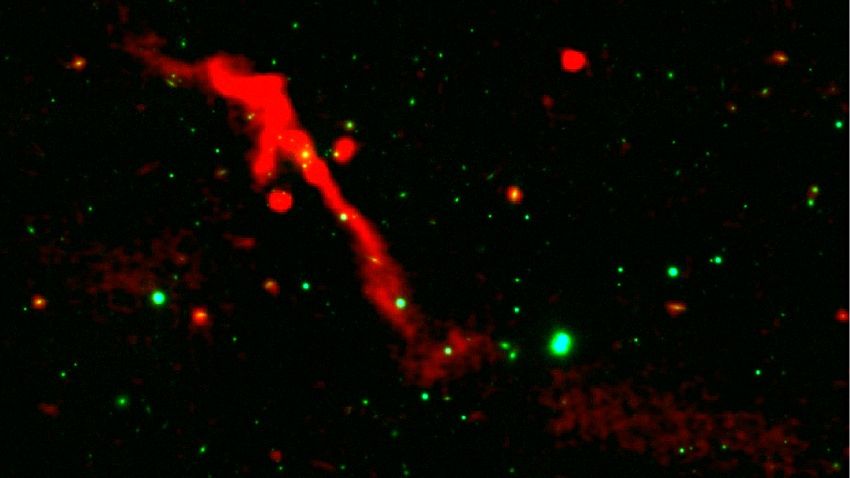
Astronomers have now captured this extraordinary reawakening, observing the black hole transitioning from a state of profound dormancy to one of brilliant, violent activity. According to livescience.com, the event has been likened to watching a 'cosmic volcano erupt,' offering an unprecedented real-time view of a black hole's dramatic rebirth.
The Telltale Flash in the Galactic Core
How Scientists Spotted the Eruption
The discovery began with a flash—a dramatic brightening in the core of a galaxy designated SDSS1335+0728, located approximately 300 million light-years from Earth. This wasn't a fleeting supernova but a persistent and growing luminosity emanating from the very center of the galaxy.
Observations from multiple ground and space-based telescopes confirmed the source: the supermassive black hole, with a mass estimated at about one million times that of our sun, had begun actively consuming the material around it once more. The report states that the galaxy's brightness in mid-infrared wavelengths has increased by a factor of four since December 2019, while its ultraviolet emissions have rocketed by at least a factor of ten.
Anatomy of a Black Hole's Awakening
From Cold Disk to Blazing Accretion
The transformation hinges on the behavior of the black hole's accretion disk. During its dormant phase, the gas in this disk is too cool and diffuse to emit significant light, creating a state astronomers compare to a 'starved' black hole. For reactivation to occur, a fresh influx of material—likely a star or a gas cloud straying too close—must destabilize this quiet disk.
As this new material spirals inward, it collides with existing matter, heating up through immense friction and gravitational forces. According to livescience.com, this process can reignite the entire accretion disk, turning it into a blazing, high-energy engine that emits radiation across the electromagnetic spectrum, from X-rays to radio waves. The observed changes in SDSS1335+0728 are a textbook example of this ignition sequence caught in the act.
A Rare Window into Galactic Evolution
Why This Observation is Transformative
While astronomers have seen black holes switch 'off' and suspected they can turn back 'on,' catching one in the precise moment of reactivation has remained elusive. Most observations provide only snapshots in time, making it difficult to distinguish a sudden awakening from other transient cosmic events.
This ongoing event in SDSS1335+0728 is different. The continuous brightening over several years provides a slow-motion, detailed view of the process. Scientists now have a front-row seat to watch how the influx of material alters the black hole's immediate environment and how the resulting radiation propagates outward, potentially influencing star formation in the wider galaxy.
Distinguishing a Rebirth from a Disaster
Ruling Out a Tidal Disruption Event
One initial hypothesis was that the brightening resulted from a tidal disruption event (TDE), where a star is ripped apart by a black hole's gravity. However, the observed characteristics don't fully align with a typical TDE, which usually peaks and then fades over months or a few years.
The report states that the brightness changes in SDSS1335+0728 are more consistent with an accretion disk turning on. The light curve—the graph of its brightness over time—shows a much more gradual and sustained increase, suggesting a fundamental and lasting change in the black hole's feeding state rather than a single, catastrophic meal.
The Instrumental Chorus
Telescopes Uniting to Solve the Mystery
Unraveling this event required a coordinated effort from observatories around the globe and in space. Data from the Zwicky Transient Facility first flagged the unusual activity. Follow-up observations then poured in from instruments like the European Southern Observatory's Very Large Telescope (VLT) in Chile, NASA's Neil Gehrels Swift Observatory, and the Chandra X-ray Observatory.
Each telescope contributed a different piece of the puzzle. The VLT provided detailed spectroscopic data, Swift tracked the intense ultraviolet surge, and Chandra searched for high-energy X-rays—a key signature of a black hole's hot inner accretion flow. This multi-wavelength approach was crucial for confirming the nature of the eruption.
Implications for Our Galactic Neighborhood
Could Sagittarius A* Erupt?
The event naturally raises questions about the supermassive black hole at the center of our own galaxy, Sagittarius A* (Sgr A*). Currently, it is a quiet and underfed giant. According to livescience.com, the observation of SDSS1335+0728 demonstrates that such dormancy is not necessarily permanent.
While there is no immediate cause for concern, the study shows that galactic cores can reignite on timescales that are, astronomically speaking, quite short. It provides a living model for how a sudden influx of gas, perhaps from a passing cloud or a disrupted star cluster, could one day stir Sgr A* from its slumber, fundamentally altering the energetic landscape of the Milky Way's core.
The Future of an Active Galactic Nucleus
Monitoring a Newborn Quasar
The critical question now is: what happens next? Astronomers are continuing to monitor SDSS1335+0728 closely. The black hole could continue to brighten, potentially evolving into an extremely luminous active galactic nucleus (AGN) or even a quasar—one of the brightest objects in the universe.
Alternatively, the feeding frenzy could subside if the fuel supply is cut off. Continued observation will help scientists understand the long-term stability of such reactivation events. According to livescience.com, published on 2026-01-20T21:45:08+00:00, this single galaxy offers a unique laboratory to test theories about the life cycles of supermassive black holes that have existed only in models and simulations until now. The cosmic volcano is still erupting, and its lava flow of data is reshaping our understanding of galactic hearts.
#BlackHole #Astronomy #SpaceDiscovery #Galaxy #Astrophysics


