

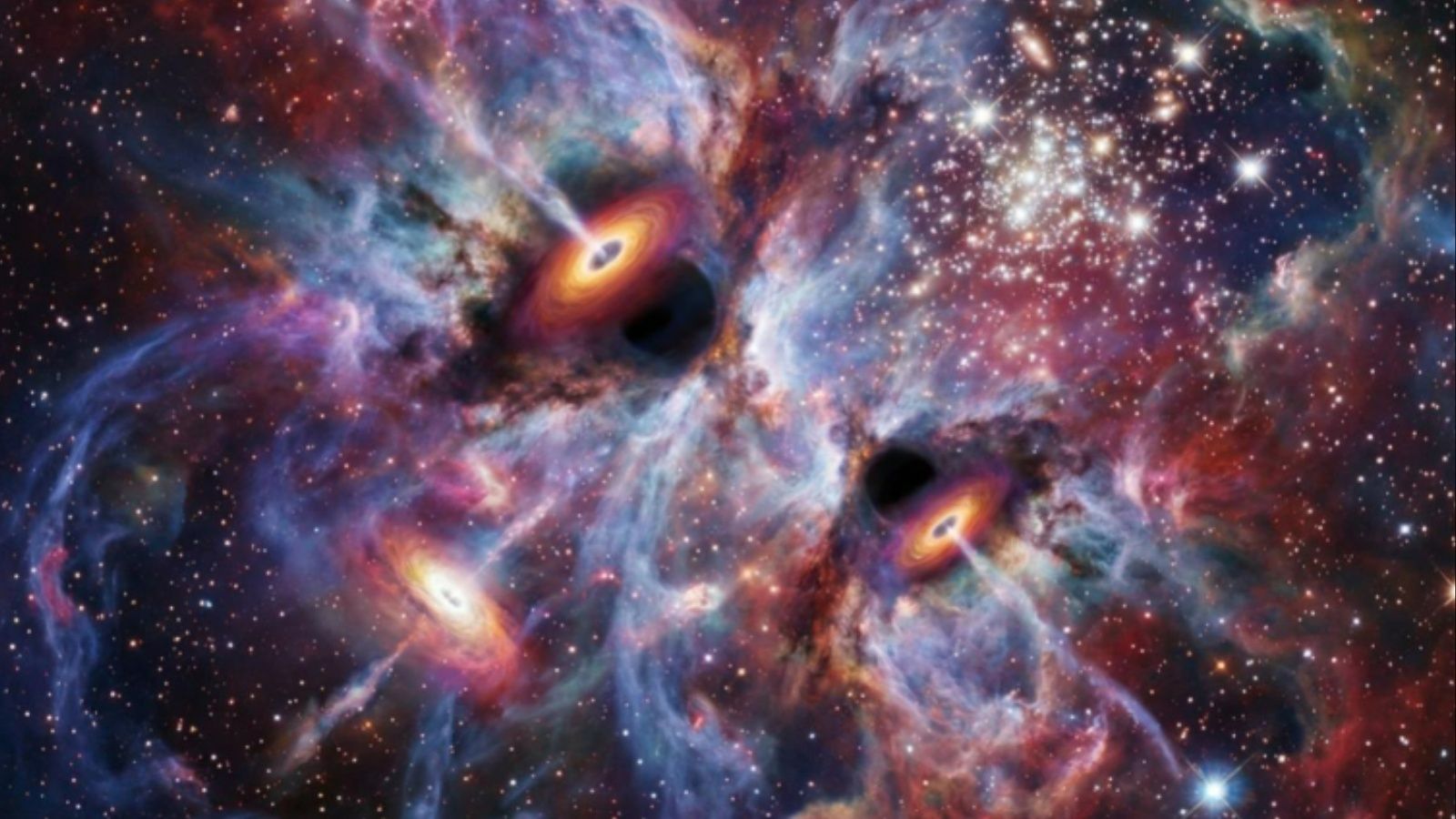
Black Hole Feeding Frenzy May Solve Webb's Early Universe Mystery

📷 Image source: cdn.mos.cms.futurecdn.net
A Cosmic Conundrum in the Infant Universe
Webb's Discovery of Unexpectedly Bright Galaxies
The James Webb Space Telescope (JWST) has presented astronomers with a profound puzzle. Peering back to the universe's infancy, it has spotted galaxies that are far too bright and massive to exist so soon after the Big Bang. According to space.com, these observations challenge our fundamental understanding of how the first stars and galaxies assembled in the cosmic dawn.
This cosmic mystery, detailed in a report from space.com on 2026-01-22T22:00:00+00:00, suggests something must have supercharged the growth of these early structures. The leading hypothesis? A rampant, chaotic era where voracious black holes feasted on surrounding gas at an unprecedented rate, flooding their nascent galaxies with intense radiation.
The Engine of Chaos: Supermassive Black Hole Feeding Frenzy
How Black Holes Could Power Early Galactic Growth
The proposed solution centers on supermassive black holes. In the modern, more settled universe, these cosmic behemoths often lurk quietly at galactic centers. But in the chaotic conditions shortly after the Big Bang, researchers suggest they may have entered a state of uncontrolled gluttony.
During this 'feeding frenzy,' black holes would have consumed vast amounts of gas from their surroundings at rates nearing their theoretical limits. As matter spiraled into the black hole's gravitational grip at incredible speeds, it would have formed a superheated accretion disk, emitting torrents of energy across the electromagnetic spectrum. This radiation could have provided the extra luminosity Webb detects, making host galaxies appear anomalously bright.
Radiation Pressure and Galactic Feedback
The Physical Mechanism Behind the Brightness
The key to this model lies in a concept known as radiation pressure. As the black hole feasts, the intense radiation pouring from its accretion disk pushes outward against the in-falling material. According to the space.com report, this creates a self-regulating cycle of feast and famine—a feedback loop where the black hole's own brilliance can choke off its food supply.
This process is crucial. The tremendous energy output doesn't just make the galactic core shine; it can heat and expel gas throughout the entire host galaxy. This heated gas glows brightly, potentially explaining why these entire galactic systems appear so luminous to Webb's infrared eyes, rather than just their central black holes.
Challenging the Stellar Formation Narrative
Why Star Formation Alone Falls Short
Prior to Webb's findings, conventional models held that the brightness of early galaxies was predominantly fueled by intense bursts of star formation. However, the sheer scale and early timing of the brightness Webb observes strain this explanation. Forming enough stars to generate that luminosity would require a pace and efficiency that seems physically difficult to achieve in the universe's first few hundred million years.
The black hole feeding frenzy model offers an alternative power source. A single, rapidly accreting supermassive black hole can outshine billions of stars, providing a more plausible engine for the extreme energies detected. This suggests that black holes and their host galaxies may have co-evolved and influenced each other's growth from the very beginning in a more direct and violent way than previously thought.
Simulating the Ancient Cosmic Drama
Computer Models That Recreate Frenzied Growth
To test this hypothesis, astronomers are turning to sophisticated computer simulations. These models attempt to recreate the conditions of the early universe, seeding it with primordial gas, dark matter, and the seeds of early black holes. The goal is to see if, under the right chaotic conditions, these black hole seeds can grow rapidly enough through frenzied accretion to produce the luminous signatures Webb sees.
The simulations must account for complex physics: gravity pulling gas inward, the hydrodynamics of gas clouds collapsing, and the potent feedback from radiation that both illuminates and disrupts the accretion process. Early results from such work, as noted in the space.com article, show promise, demonstrating pathways where black holes can briefly achieve these extreme states of hyper-accretion.
The Origin of the First Black Hole Seeds
The Unanswered Precursor Question
This frenzy theory, while compelling, immediately raises another profound question: where did the initial black holes that began this feeding come from? To enter a frenzy, you first need a substantial black hole seed. Explaining the existence of such seeds so early in cosmic history remains a major frontier in astrophysics.
Two primary candidates exist. The first is the remnants of the universe's very first generation of stars, known as Population III stars. These behemoths, composed only of hydrogen and helium, could have lived fast, died young, and collapsed directly into black holes. The second, more exotic possibility is the direct collapse of massive primordial gas clouds, bypassing the star formation stage entirely to form a black hole seed directly. The frenzy model depends on which of these pathways—or another yet unknown—actually occurred.
Future Observations to Test the Frenzy Hypothesis
How Astronomers Will Seek Confirmation
The next step is to move from simulation to confirmation with new observations. The feeding frenzy model makes specific, testable predictions. The intense radiation from a frenzied black hole should produce certain spectral signatures—specific fingerprints of light—that differ from those produced by a galaxy dominated by young, hot stars.
JWST itself, with its powerful spectrographs, is ideally suited to this task. By taking detailed spectra of these puzzlingly bright early galaxies, astronomers will search for the tell-tale signs of dense, high-velocity gas swirling in an accretion disk, or emission lines characteristic of material under the extreme influence of a black hole's energy. Finding these signatures would be strong evidence that the frenzy is real.
Implications for Galaxy Evolution
Rewriting the Story of Cosmic Dawn
If the black hole feeding frenzy hypothesis holds, it would force a significant rewrite of the early chapters of our cosmic history. It would mean that supermassive black holes were not mere latecomers or passive occupants, but primary actors that fundamentally shaped their environments from the outset.
Their violent growth spurts would have injected enormous energy into the first galaxies, potentially quenching star formation by blowing away gas, or conversely, triggering it by compressing gas clouds. This dynamic interplay between black hole and galaxy—a form of cosmic feedback—may have been established in the universe's first few hundred million years, setting the template for how all subsequent galaxies, including our own Milky Way, would evolve over billions of years.
#JamesWebb #BlackHoles #EarlyUniverse #Astronomy #SpaceDiscovery


