

Cosmic Mirage: Astronomers Capture Twin Supernovas in a Gravitational Hall of Mirrors

📷 Image source: cdn.mos.cms.futurecdn.net
A Celestial Paradox in the Distant Cosmos
How one galaxy's gravity creates two images of the same stellar explosion
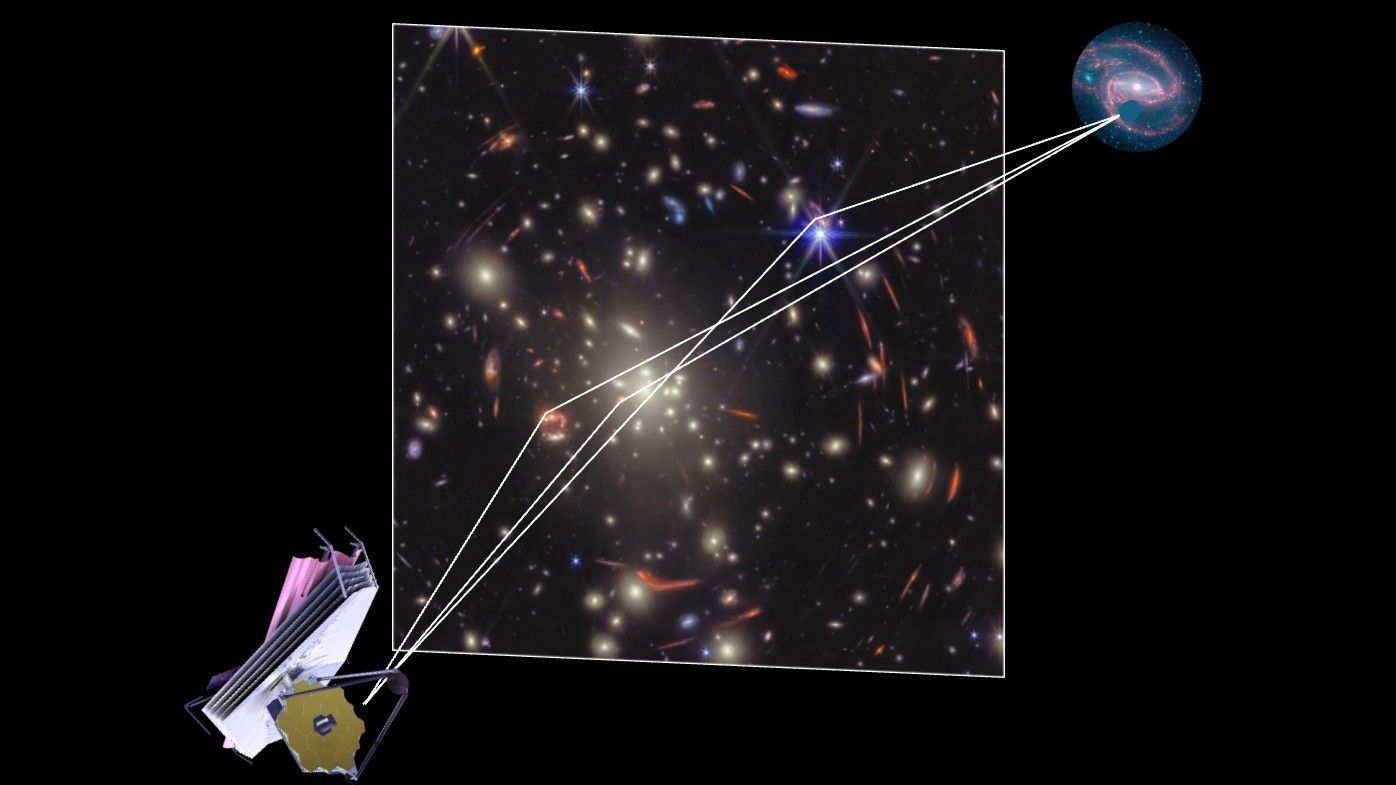
Astronomers have documented a cosmic event that seems to defy simple logic: a pair of supernovas whose light has both reached Earth and, in a sense, has not. According to a report from livescience.com, this phenomenon isn't a trick of the eye but a profound demonstration of gravitational lensing, where the immense gravity of a foreground galaxy cluster acts like a colossal lens in space. This lens warps and magnifies the light from a single, far more distant supernova, creating multiple images of the same cataclysmic event that arrive at Earth at different times.
The discovery, detailed in a study published in the journal Nature Astronomy, hinges on the detection of two bright, transient objects in archival data from the Hubble Space Telescope. These objects, spotted in a galaxy roughly 9.3 billion light-years away, were initially catalogued as separate supernovas. However, further analysis revealed they were not two different stars exploding, but two separate images of the exact same supernova, its light split and bent along different paths around an intervening galaxy cluster. This cluster, known as MRG-M0138, is so massive that it distorts the very fabric of spacetime around it.
The Gravitational Lens: Nature's Ultimate Telescope
The mechanism at play is a cornerstone prediction of Einstein's theory of general relativity. A gravitational lens forms when a massive object, like a galaxy or a cluster of galaxies, lies directly between a distant light source and an observer. The object's gravity bends the light rays from the source, much like a glass lens bends light. In cases of perfect alignment, this can create multiple images, arcs, or even a complete ring of light—known as an Einstein ring—around the foreground mass.
In this specific observation, the lensing galaxy cluster MRG-M0138 provided the perfect cosmic alignment. The supernova, designated SN Zwicky, was located directly behind it from our vantage point on Earth. The cluster's gravity did not just magnify the supernova's light, making it appear brighter and allowing for detailed study, but it also cleaved the light's path into at least two distinct routes. One path was slightly shorter, delivering its image of the explosion to Hubble's sensors. The other path was longer, meaning that image of the very same explosion is still en route through the universe. Astronomers expect it to arrive at Earth, offering a second look at the event, in a few decades.
SN Zwicky: A Magnified Marvel of Stellar Death
Studying a supernova in unprecedented detail from across the universe
The supernova at the heart of this discovery, SN Zwicky, is itself a remarkable object. Classified as a Type Ia supernova, it is the thermonuclear explosion of a white dwarf star in a binary system. These supernovas are crucial 'standard candles' for measuring cosmic distances because they explode with a predictable, intrinsic brightness. The gravitational lensing effect from MRG-M0138 amplified SN Zwicky's light by a factor of 25, transforming it from a faint, distant speck into an object bright enough for in-depth spectroscopic analysis.
This magnification allowed researchers to peer into the chemical composition and physics of the explosion with a clarity typically reserved for much closer events. According to the livescience.com report, the detailed study of SN Zwicky provides a rare, magnified benchmark for understanding the uniformity of Type Ia supernovas across vast stretches of time and space. Confirming their consistency even when viewed through the extreme lens of 9.3 billion years of cosmic history strengthens their role as fundamental tools for cosmology.
The Time Delay: A Glimpse into the Future and the Past
The most mind-bending aspect of this discovery is the time delay between the two images. The light forming the first detected image took one path around the galaxy cluster. The light for the second, future image took a longer, more circuitous route. The difference in these path lengths, combined with the time-dilating effects of traveling through the cluster's gravitational well, creates a delay estimated to be several decades.
This means astronomers have, in effect, received a preview of a cosmic event that has yet to fully arrive. They have already studied the first image of SN Zwicky's explosion. The second image, carrying the same information but from a different perspective of spacetime, is still traveling. When it finally reaches Earth, it will provide a unique opportunity. Scientists will be able to observe the same supernova explosion twice, checking if its properties appear identical from the two different light paths. This could reveal subtle details about the distribution of dark matter within the lensing cluster and test the robustness of physical laws across the universe.
Unlocking the Secrets of Dark Matter
Observations of gravitationally lensed supernovas like SN Zwicky are more than just cosmic curiosities; they are powerful probes of the invisible scaffolding of the universe. The precise way the light is bent and delayed depends on the total mass distribution within the lensing galaxy cluster. This mass is dominated not by the visible stars and gas, but by dark matter—the mysterious substance that makes up about 85% of all matter in the cosmos.
By meticulously measuring the brightness, position, and arrival time of the multiple supernova images, astronomers can map the gravitational potential of the lens with extraordinary precision. According to the research, analyzing the time delay between the two images of SN Zwicky will allow scientists to create a detailed model of how dark matter is distributed throughout the MRG-M0138 cluster. Each strongly lensed supernova acts as a single, bright point source, providing a clean measurement that helps constrain models of dark matter's properties and how it clumps together under gravity.
The Hunt for More Cosmic Mirages
The discovery of the dual-imaged SN Zwicky was made by sifting through years of archival data from Hubble. This suggests that other such 'time-warped' supernovas may already be hiding in existing astronomical datasets, waiting to be identified. The challenge lies in recognizing the transient images as belonging to the same event, which requires monitoring their evolution and comparing their spectroscopic fingerprints.
The advent of next-generation observatories is set to revolutionize this search. The Vera C. Rubin Observatory, with its ability to scan the entire visible sky every few nights, is expected to detect millions of supernovas. Among these will be hundreds, if not thousands, that are gravitationally lensed. The Nancy Grace Roman Space Telescope, with Hubble-like clarity but a field of view 100 times larger, will be uniquely positioned to conduct deep, wide-field surveys ideal for finding these rare, multiply-imaged events.
This impending flood of data will transform lensed supernovas from rare jewels into a statistical sample. Researchers will be able to use them not just as individual case studies, but as a population to conduct large-scale surveys of cosmic expansion and dark matter distribution.
A New Era for Precision Cosmology
The implications of studying lensed supernovas extend to one of cosmology's greatest mysteries: the nature of dark energy, the force driving the accelerated expansion of the universe. Measuring cosmic distances and expansion rates with extreme accuracy is key to understanding dark energy. Type Ia supernovas are already a premier tool for this, but their utility is limited by uncertainties in their intrinsic brightness and by interstellar dust that can dim their light.
Gravitational lensing offers a way to circumvent some of these issues. A lensed supernova is, by definition, magnified, making it observable at greater distances and with less interference from dimming effects. Furthermore, the time delay between multiple images provides an independent method to measure the distance to the supernova and its host galaxy. This distance measurement relies purely on geometry and gravity, offering a cross-check against methods that depend on the supernova's assumed brightness.
As the livescience.com report highlights, using lensed supernovas as standard candles could therefore calibrate the cosmic distance ladder with new precision and provide tighter constraints on the properties of dark energy, potentially revealing whether its strength has changed over the lifetime of the universe.
A Testament to Archival Science and Patient Observation
This discovery underscores the enduring value of archival data and long-term, patient observation in astronomy. The images of SN Zwicky were not found in real-time but were pieced together from observations spanning years. The first image was captured, and then the event faded from view. The knowledge that a second image is coming requires astronomers to now wait, to monitor that precise patch of sky for decades.
It is a powerful reminder that the universe operates on timescales vastly different from our own. A single stellar explosion, over nine billion years old, is giving us two distinct moments of observation separated by a human lifetime. The study, published on livescience.com on 2026-01-31T16:00:00+00:00, represents not an endpoint but an intermission. Astronomers have catalogued the first act of SN Zwicky's appearance. They now have a prediction, written in the laws of physics, for when the final curtain will rise on its second, delayed encore, offering a repeat performance of a cosmic catastrophe from the deep past.
#Astronomy #GravitationalLensing #Supernova #Einstein #Hubble #SpaceDiscovery


