

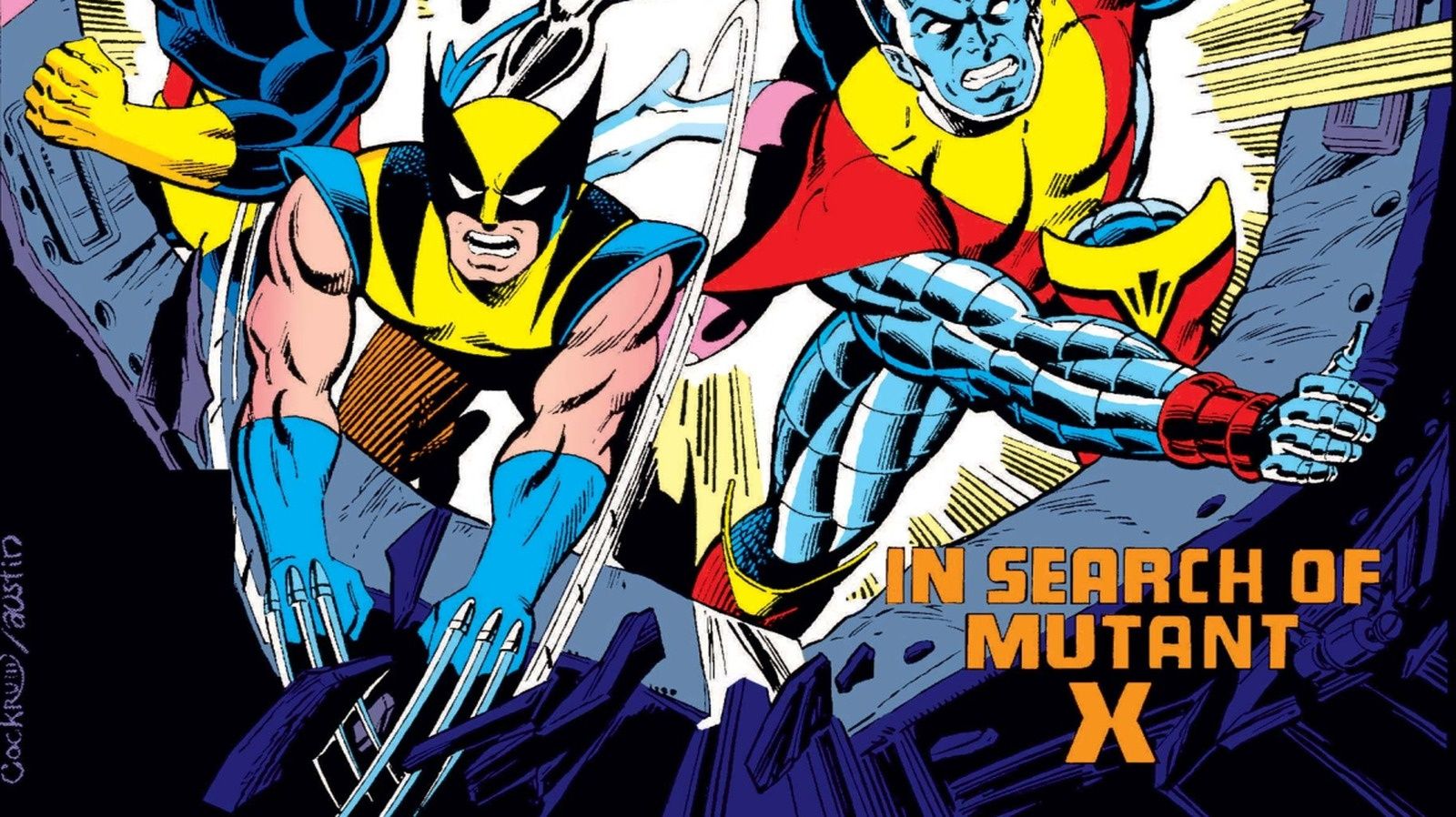
The Mutants That Almost Were: Stan Lee's Original Name for the X-Men and the Evolution of a Marvel Legacy

📷 Image source: slashfilm.com
A Name Lost to History
The Genesis of an Idea
In the annals of comic book history, few creation stories are as iconic as that of the X-Men. The team of mutant superheroes, fighting for a world that fears and hates them, has become a cornerstone of Marvel Comics and a global cinematic phenomenon. However, according to a report from slashfilm.com, the foundational name we now take for granted was not the first choice of its legendary co-creator, Stan Lee.
The original title Lee conceived for the series, as detailed in the source material, was 'The Mutants.' This straightforward, descriptive name was ultimately set aside in favor of the more enigmatic and now-immortal 'X-Men.' This pivotal decision, made in the early 1960s, set the stage for a franchise that would explore themes of prejudice, otherness, and social integration for decades to come, fundamentally shaping its identity.
Why "The Mutants" Didn't Stick
A Publisher's Prerogative
The shift from 'The Mutants' to 'X-Men' was not merely a creative whim. According to the historical account on slashfilm.com, the primary reason was a practical concern from Marvel's then-publisher, Martin Goodman. Goodman reportedly feared that the term 'mutants' would be too unfamiliar to the average young reader in the early 1960s. The concept of genetic mutation, while a staple of science fiction, was not yet mainstream popular vocabulary.
This editorial intervention highlights the commercial realities of comic publishing at the time. Titles needed to be immediately graspable and marketable. 'The Mutants,' while accurate, was seen as potentially confusing or off-putting. This led Stan Lee and artist Jack Kirby to pivot, seeking a name that retained the core concept but packaged it in a more accessible and dramatic way, ultimately landing on the professor's 'school for gifted youngsters' framework.
The Birth of "X-Men"
Finding the Extra Factor
With 'The Mutants' deemed unsuitable, the creative team needed a new hook. The solution brilliantly tied the team's origin to its founder, Professor Charles Xavier. The 'X' in X-Men directly references his surname, symbolizing his role as the mentor and architect of the team. This created an immediate personal connection and a sense of legacy.
Furthermore, the name 'X-Men' carried multiple layers of meaning. Beyond the Xavier connection, the 'X' evoked the mathematical unknown, a perfect metaphor for the mysterious and unpredictable nature of mutation. It also suggested the 'extra' power these individuals possessed. The name was catchy, short, and possessed a certain poetic ambiguity that 'The Mutants' lacked, allowing for richer thematic exploration beyond mere biological classification.
Comparative Analysis: A Global Perspective on Naming
How Different Cultures Frame the Other
The evolution from 'The Mutants' to 'X-Men' offers a fascinating lens through which to examine how different cultures name and frame groups perceived as 'other.' In many Western narratives, the unknown or the super-powered is often given a letter or symbol—'X,' 'Project 0,' 'Class S'—to denote mystery and power. The X-Men name fits squarely within this tradition.
Contrast this with naming conventions in other global mythologies or contemporary media. Some cultures' stories might integrate such beings directly into societal or spiritual hierarchies with specific, honorific titles, rather than abstract labels. The choice to avoid the clinical 'Mutants' in favor of a name tied to a patriarch (Xavier) also reflects a common narrative trope of grouping outsiders under a guiding figure, a theme seen in various forms worldwide, from martial arts schools to philosophical movements.
Thematic Impact of the Name Change
From Label to Legacy
Had the series launched as 'The Mutants,' its entire narrative trajectory might have been subtly different. That name frames the characters primarily by their biological condition. It is a label imposed by their genetics, potentially placing the emphasis squarely on their difference as a scientific fact. Stories might have leaned harder into pure science fiction tropes of evolution and species replacement.
The name 'X-Men,' however, immediately suggests a chosen family, a brotherhood under a banner. The 'Men' (though later inclusive of many women) implies a collective identity, a team forged by choice and mission, not just biology. This allowed writers to balance stories about persecution based on innate traits with stories about chosen duty, mentorship, and internal group dynamics. The name created space for the school setting, which became a crucial metaphor for both sanctuary and education.
Mechanisms of Cultural Integration
How a Name Builds a Bridge
The success of 'X-Men' as a name demonstrates a key mechanism in making fringe concepts palatable to a mainstream audience. By anchoring the team to a relatable human figure (Professor X) and using the familiar 'school' trope, the concept of mutation was given a safe, structured context. Readers weren't just introduced to 'mutants'; they were introduced to Cyclops, Marvel Girl, Iceman, Angel, and Beast—individual characters with distinct personalities whose powers were just one facet of their identity.
This narrative framing, enabled by the more nuanced title, allowed the comics to gradually introduce complex social allegories. The audience learned to care about the characters as people first, which made the prejudice they faced as 'mutants' more emotionally resonant. The name 'X-Men' served as a gateway, softening the potentially alienating scientific premise of 'The Mutants' and allowing the deeper themes to land with greater impact over time.
Risks and Limitations of the Chosen Name
The Gender Debate and Fixed Identity
While 'X-Men' proved successful, it was not without its own limitations and controversies. The most persistent critique is the gendered language. Despite featuring powerful female characters like Jean Grey and Storm from early on, the team name inherently masculinizes the group. This has led to ongoing debates within the fandom and the comics themselves, with various spinoff titles like 'X-Factor' or simply 'X-Force' attempting sidesteps, and in-universe characters occasionally questioning the name.
Another limitation is that the name permanently ties the team's identity to Charles Xavier. While this provided strong foundational mythology, it also created narrative constraints. Stories that move beyond Xavier's vision or leadership, or that focus on mutant cultures that explicitly reject his dream, still operate under the banner he created. The name can sometimes feel anachronistic or overly centered on one man's philosophy, even as the franchise explores vastly different mutant experiences and ideologies.
Historical Context: Comics in the Early 1960s
The Landscape of Innovation
To fully appreciate this naming decision, one must understand the comic book industry of 1963 when 'The X-Men' #1 was published. This was the heart of the Marvel Age of Comics, a period of tremendous innovation led by Stan Lee, Jack Kirby, and Steve Ditko. They were creating characters with flawed personalities and real-world problems, a departure from the perfect, archetypal heroes of the previous era.
In this context, naming a team 'The Mutants' would have been a bold, almost clinical, science-fiction move. Other Marvel titles of the time, like 'The Fantastic Four,' 'The Avengers,' and 'The Amazing Spider-Man,' used evocative adjectives or collective nouns. 'The Mutants' stood apart as a blunt, taxonomic title. The shift to 'X-Men' brought the new team more in line with the naming conventions of its peers, while the 'X' provided enough unique flair to make it stand out on the newsstand.
The Name's Evolution in Film and Media
From Page to Global Screen
The journey of the name 'X-Men' from comic book panels to global cinema is a testament to its enduring power. When the film franchise launched in 2000, the title was already a well-established brand with 37 years of history. The movies, however, faced the same challenge Martin Goodman foresaw: explaining 'mutants' to a mass audience. The films used dialogue and visual storytelling to define the term, making the once-esoteric concept a household word.
Interestingly, the cinematic success has led to a reversal in terminology. Where Goodman feared 'mutants,' the film era has fully embraced it as the in-universe term for the characters' condition. 'Mutant' is now the common parlance, with 'X-Men' specifically denoting the team aligned with Xavier's dream. This demonstrates how a name chosen for accessibility can, over decades, educate its audience to the point where the original, rejected term becomes fully integrated and understood.
Privacy and Identity: A Core Mutant Dilemma
To Hide or to Declare
The naming debate between 'The Mutants' and 'X-Men' touches on a central, persistent theme in all X-Men narratives: the conflict between privacy and public identity. 'Mutant' is an inherent, often hidden, state of being. The choice to reveal oneself as a mutant is a profound personal and political decision, with risks of persecution, violence, and alienation.
The name 'X-Men,' by comparison, represents a public declaration. It is a chosen identity, a uniformed stance. Characters who wear the 'X' are openly aligning themselves with a cause and a community, often sacrificing any chance of a normal, private life. This tension between the private truth of being a mutant and the public act of being an X-Man is the engine for countless stories, from Nightcrawler's struggles with his appearance to the political debates between Professor X and Magneto. The very name of the team encapsulates this choice.
Perspektif Pembaca
The story of the X-Men's name is more than a piece of trivia; it's a case study in how foundational choices can shape narratives about identity and belonging for generations. Does knowing that 'The Mutants' was the original concept change how you view the stories? Does the name 'X-Men' still feel relevant and inclusive for the vast, diverse universe of characters it represents today?
We want to hear from you. Share your perspective: Do you think the franchise would have developed a different cultural significance or explored its core themes in a fundamentally altered way if it had launched under the title 'The Mutants'? How do you see the legacy of this naming decision playing out in the future of Marvel's mutant stories?
#XMen #Marvel #StanLee #ComicHistory #Mutants


