

The Cosmic Waltz: How Orbital Resonance Shapes Our Solar System and Beyond

📷 Image source: earthsky.org
Introduction: The Hidden Rhythm of the Heavens
Beyond Random Orbits
The night sky often appears as a collection of silent, independent lights following their own paths. This perception, however, masks a profound and widespread cosmic phenomenon where celestial bodies move in precise, synchronized harmony. This gravitational coordination, known as orbital resonance, acts as an invisible conductor for the solar system's long-term stability and architecture.
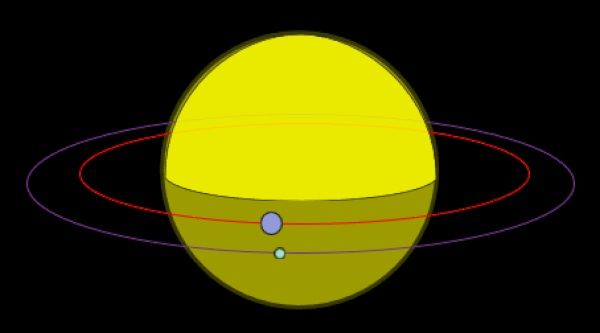
According to earthsky.org, orbital resonance occurs when two orbiting bodies exert a regular, periodic gravitational influence on each other. This influence is most powerful when their orbital periods—the time it takes to complete one lap around their primary body—form a simple ratio of whole numbers, like 2:1 or 3:2. This relationship locks the bodies into a repeating gravitational dance that can protect or disrupt their paths over millions of years.
The Mechanics of the Dance: How Resonance Works
Gravity's Repeating Nudge
Orbital resonance is not a physical connection but a persistent gravitational conversation. Imagine two moons orbiting a planet. If the inner moon completes exactly two orbits for every one orbit of the outer moon, they will repeatedly meet at the same points in space. Each close encounter allows their gravity to give the other a small, consistent tug.
These repeated, timed tugs accumulate over astronomical timescales. Instead of canceling each other out, they amplify specific effects. This can gently pump energy into an orbit, making it more elliptical, or efficiently remove energy, circularizing a path. The key is the regularity; the gravitational kicks happen at the same orbital phase, creating a feedback loop that locks the rhythm in place. It is a delicate balance maintained by the fundamental laws of motion and gravity.
A Famous Trio: Jupiter's Moons in Lockstep
The Galilean Resonance
One of the most celebrated examples resides with Jupiter. Three of its four largest moons—Io, Europa, and Ganymede—are locked in a 4:2:1 Laplace resonance. For every four orbits completed by Io, the innermost moon, Europa completes two and Ganymede completes one. This precise configuration is a masterpiece of gravitational dynamics that has persisted for billions of years.
This resonance has profound physical consequences, particularly for Io. The constant, periodic gravitational squeezes from its neighboring moons generate immense tidal friction within Io. This friction heats its interior, making Io the most volcanically active body in the solar system, as noted by earthsky.org. The resonance thus transforms what might be a cold, inert world into a geological inferno, demonstrating how orbital synchrony directly shapes planetary conditions.
Architect of the Asteroid Belt: The Kirkwood Gaps
Where Resonance Clears Space
Orbital resonance can also be a destructive, clearing force. This is vividly displayed in the main asteroid belt between Mars and Jupiter. Within the belt, there are narrow, empty regions known as Kirkwood gaps. These gaps are not random; they occur at orbital distances where an asteroid's period would resonate with Jupiter's.
For instance, an asteroid in a 3:1 resonance with Jupiter would orbit the Sun three times for every one Jovian orbit. Jupiter's relentless gravitational pulls at the same point in the asteroid's orbit each time would systematically perturb its path. Over millions of years, this resonance pumps orbital energy into the asteroid, dramatically altering its trajectory and eventually ejecting it from the belt entirely. This process acts as a gravitational broom, sweeping specific orbits clean and sculpting the belt's population.
Planetary Defense: Resonances as Stabilizers
Protecting Orbits from Chaos
While some resonances eject objects, others provide remarkable long-term stability. This protective role is evident in the Pluto system and among Neptune's Trojan asteroids. Pluto, despite its elliptical orbit that crosses Neptune's path, is in a stable 2:3 resonance with the giant planet. For every two orbits Pluto makes, Neptune completes three, ensuring they are never close during their alignment.
This timing is a celestial avoidance agreement. When Pluto is at its closest point to Neptune's orbit, Neptune is always far away in its own, slower path. This resonance has likely prevented a catastrophic close encounter or ejection for billions of years. Similarly, groups of asteroids locked in resonance with Neptune (Trojans) or Jupiter are shepherded into stable positions, demonstrating resonance's role as a cosmic peacekeeper.
Beyond Our Solar System: Exoplanets in Sync
Resonant Chains in Alien Suns
The discovery of thousands of exoplanets has revealed that orbital resonance is not unique to our solar neighborhood. In fact, some distant planetary systems exhibit even more intricate resonant chains. A notable example is the system around the star TRAPPIST-1, which hosts seven Earth-sized planets. According to earthsky.org, the inner five or six planets are locked in a complex chain of near-perfect resonances with their neighbors.
Such multi-planet resonances suggest these systems formed gently and migrated inward together in a disk of gas and dust, rather than through violent collisions. The persistence of these delicate chains provides astrophysicists with a fossil record of the system's formation conditions. Studying them helps constrain models of planet formation and migration, offering a window into the diverse architectures of planetary systems across the galaxy.
Historical Context: From Kepler to Modern Astrophysics
Evolving Understanding of Harmony
The concept of celestial harmony has deep roots. Johannes Kepler, in the 17th century, was captivated by the idea of a "music of the spheres," attempting to relate planetary orbits to nested Platonic solids and musical intervals. While his specific model was incorrect, his intuition about mathematical order in orbital spacing was prescient. The modern, rigorous understanding of orbital resonance developed much later with the advancement of celestial mechanics and perturbation theory.
Today, powerful computer simulations allow scientists to model the gravitational dance of millions of particles over billions of years. These simulations show how resonances naturally emerge from the chaotic early solar system and play a decisive role in sculpting its final structure. This journey from philosophical speculation to precise computational physics underscores how resonance is a fundamental, predictable outcome of gravitational physics.
The Limits and Uncertainties of Resonance
A Delicate and Evolving Balance
While orbital resonance creates stunning stability, it is not always permanent or perfect. Resonances can be broken by significant external perturbations, such as a close stellar flyby or the gravitational influence of a massive, undiscovered planet. Furthermore, many observed resonances are 'mean-motion resonances,' where the orbital periods are in a simple ratio on average, but the alignment is not perfectly precise at every cycle.
There is also significant uncertainty regarding how some of the most delicate resonant chains, like that in the TRAPPIST-1 system, survive for billions of years. The exact damping effects within the primordial protoplanetary disk that allowed migration to halt precisely at these resonant points are still active areas of research. These gaps in knowledge highlight that resonance is a dynamic state, not a static one, within an ever-evolving galactic environment.
Broader Impacts: From Spacecraft Trajectories to Planetary Formation
Practical and Theoretical Applications
Understanding orbital resonance has direct practical applications. Space mission planners use resonant orbits for gravity-assist maneuvers, where a spacecraft uses a planet's gravity to slingshot itself further into the solar system, often employing resonant returns to meet another planet years later. The principles of resonance are also crucial for placing satellites in stable, long-term orbits around Earth and for predicting the long-term evolution of space debris fields.
On a theoretical level, resonance is a key mechanism in the grand model of planetary system architecture. It explains the absence of planets in certain zones, the clustering of small bodies like Kuiper Belt objects, and the intense heating of moons like Io. It is a unifying concept that connects disparate phenomena—from volcanism to asteroid distribution—under the umbrella of gravitational synchronization, providing a coherent narrative for solar system history.
Future Frontiers: Unanswered Questions
The Search for New Resonant Patterns
As observational technology advances, new questions about orbital resonance emerge. Will we find more complex, higher-order resonances in the outer solar system among distant Kuiper Belt Objects, potentially hinting at past planetary migrations or unseen masses? How common are ultra-stable resonant chains like TRAPPIST-1's in the Milky Way, and what does their prevalence say about typical formation conditions for rocky planets?
Furthermore, the role of resonance in binary or trinary star systems, where gravitational influences are even more complex, is poorly understood. Missions like the James Webb Space Telescope and the upcoming Vera C. Rubin Observatory will provide data on fainter, smaller objects and exoplanet atmospheres, potentially revealing new resonant relationships that challenge or refine our current models of celestial mechanics.
Perspektif Pembaca
The discovery of intricate orbital resonances, both in our backyard and in distant star systems, challenges our view of the cosmos as a place of chaotic collisions. It reveals a deep, mathematical order imposed by gravity over eons.
What aspect of this gravitational 'music' do you find most compelling: its power to create astonishing geological activity (like Io's volcanoes), its role as a protective force for stable orbits, or its potential as a clue to how planetary systems are born? Share which resonant phenomenon captures your imagination and why.
#OrbitalResonance #SolarSystem #Astronomy #GravitationalDynamics #SpaceScience


